
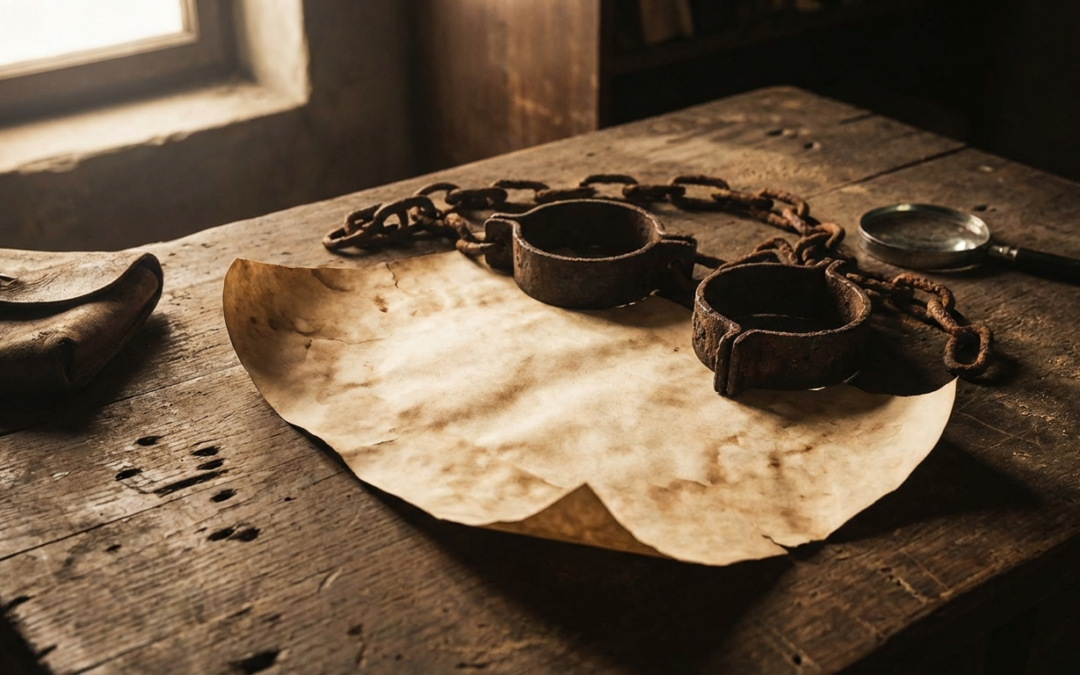
Black Codes: The Laws That Kept Us Enslaved After Slavery Ended
They signed the Emancipation Proclamation in 1863. They ratified the 13th Amendment in 1865. And then they put Black people right back where they were. (What Black Women Built)
They called them “Black Codes.”
Not slavery. Not technically. But if you couldn’t leave your employer’s land without a pass… if you could be arrested for not having a job… if your children could be “apprenticed” to your former enslaver against your will…
What exactly would you call it?
These laws swept through Mississippi, South Carolina, Louisiana, Alabama — every state that had just “lost” the war. They moved fast. Mississippi passed theirs in November 1865. The war had barely ended.
What the Black Codes Actually Said
Let’s be specific, because the details matter.
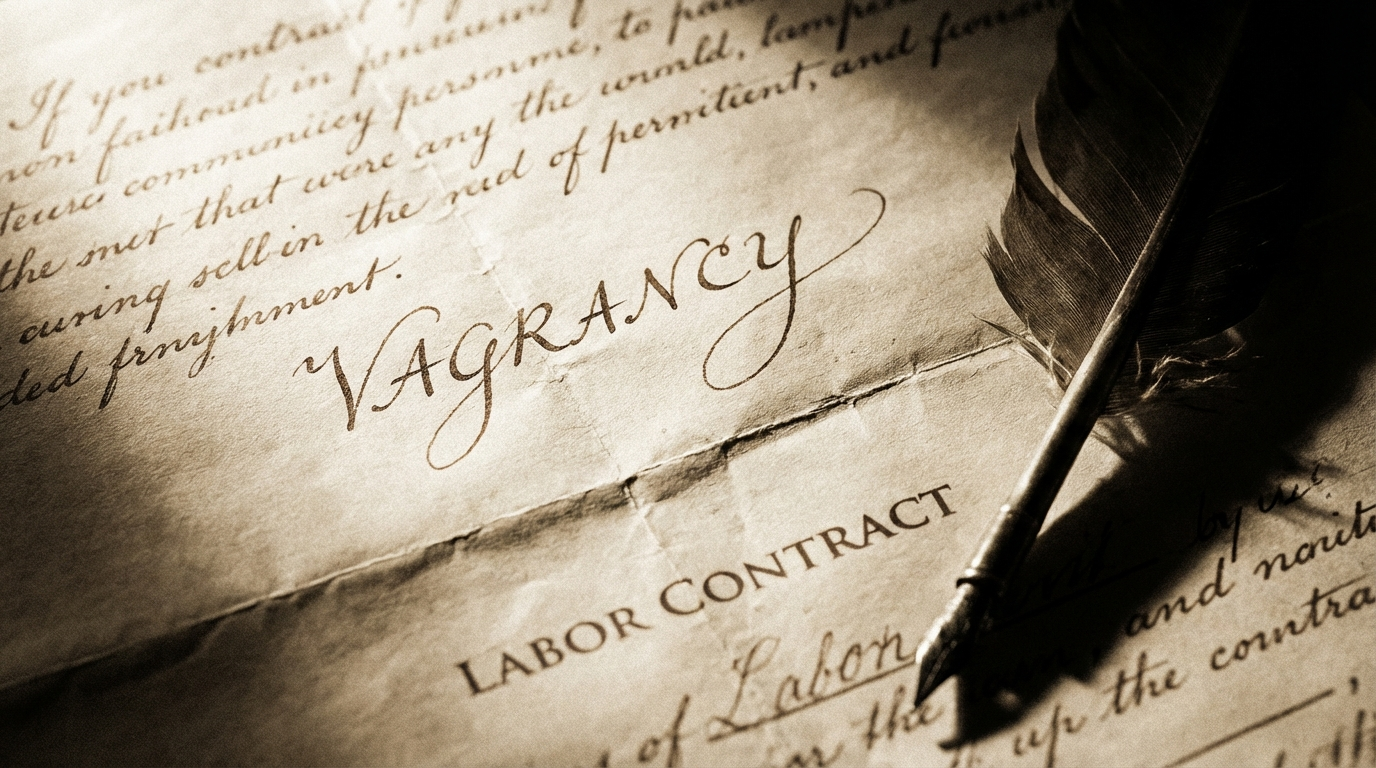
Vagrancy laws: If you were Black and couldn’t prove you had employment, you were arrested. The penalty? Forced labor. They’d literally lease you out to a plantation. Sound familiar?
Apprenticeship laws: Black children — especially orphans — could be taken from their families and forced to work for white “masters” until they turned 21. Former enslavers got first dibs. That’s not a metaphor. It was written into the law.
Labor contracts: Black workers had to sign year-long contracts by January 1st or face arrest. Leave before the contract ended? Forfeit your entire year’s wages. Every penny.
Restricted movement: In some states, Black people needed written permission to travel. In others, they couldn’t own property in certain areas. They couldn’t testify against white people in court.
They stripped the word “slavery” out and kept every single mechanism.
The Blueprint That Never Went Away
Here’s what makes Black Codes more than a history lesson — they were a blueprint.
Convict leasing. Jim Crow. Redlining. Mass incarceration. Every system that came after borrowed from this playbook: make the law sound neutral, then enforce it selectively against Black people.
The 13th Amendment itself has a loophole big enough to drive a prison bus through: “except as a punishment for crime.” The Black Codes turned that exception into an industry.
Vagrancy laws became “loitering” charges. Apprenticeship laws became the foster care pipeline. Labor contracts became sharecropping. The names changed. The function didn’t.
✊🏾 Join 500,000+ families keeping Black history alive at home.
Get tools, stories, and exclusive offers delivered to your inbox.
Why They Don’t Teach This in Schools

Ask yourself: Why is “Black Codes” a trending search right now?
Because people are Googling what their schools never taught them. Because when you skip the chapter between slavery and Jim Crow, everything that came after looks like it happened in a vacuum. Like racism just… appeared from nowhere.
Black Codes are the missing chapter. They explain how a country that “freed” 4 million people immediately built a legal system to trap them again. They explain why Reconstruction failed. They explain why the 14th and 15th Amendments had to exist at all.
And they explain why, 160 years later, we’re still fighting some of the same fights.
What Your Kids Need to Know
This isn’t about making children feel helpless. It’s about making them informed.
When your child understands Black Codes, they understand that freedom has always been something our people had to fight to keep — not just win once. They understand that laws can be weapons. They understand that the system wasn’t broken; it was built this way.
That’s not despair. That’s power.
Because when you can name the thing, you can fight the thing.
That’s exactly why we created Black History Flashcards — to put the full, uncut story in your family’s hands. Not the sanitized version. The real one. The one that includes Black Codes and the people who fought to tear them down.
The People Who Fought Back
Don’t let anyone tell you Black people just accepted this.
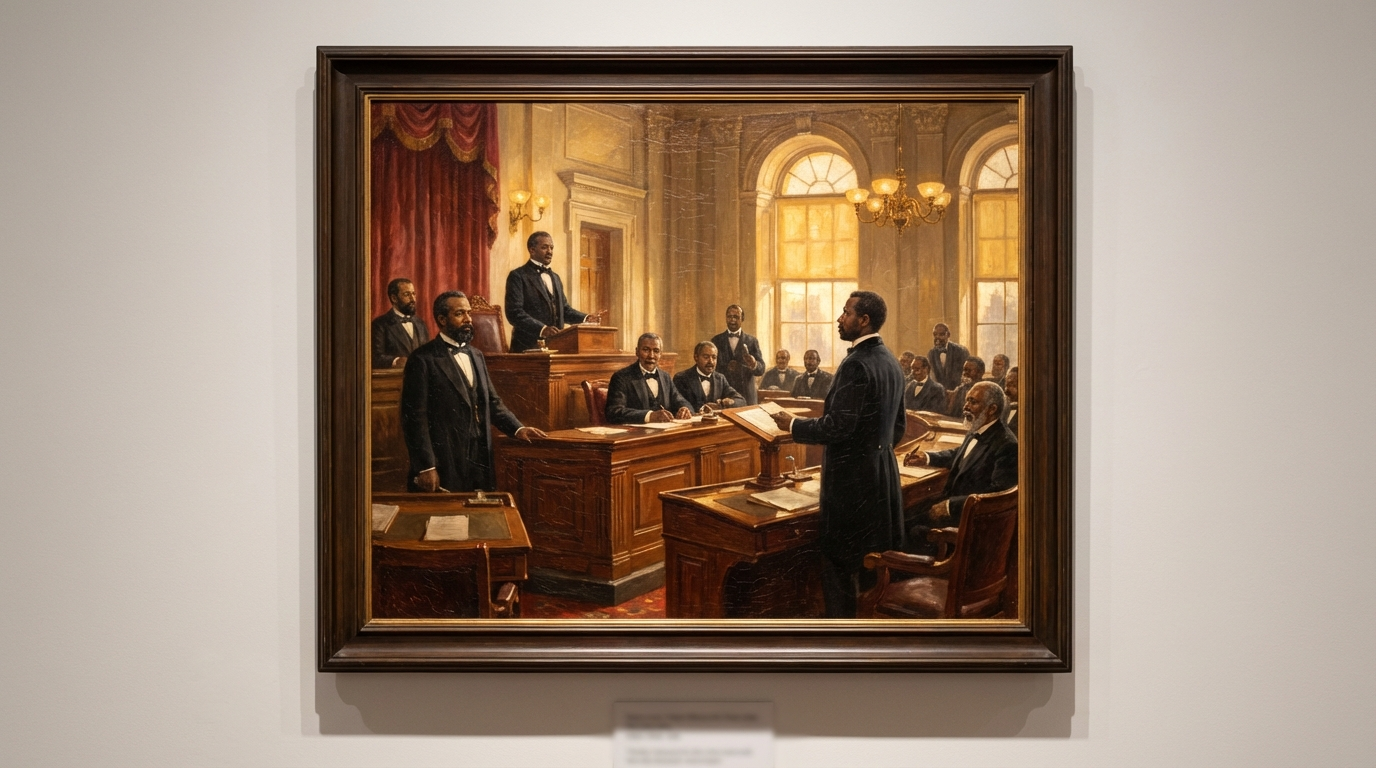
Freedmen’s Bureau agents documented the abuses and pushed back against Black Code enforcement. Black churches organized, educated, and mobilized communities. Black legislators — elected during Reconstruction — fought to repeal these laws and replace them with actual protections.
People like Robert Smalls, who went from enslaved ship pilot to United States Congressman. Or Tunis Campbell, who built self-governing Black communities in Georgia before white supremacists had him imprisoned for it.
They fought. They always fought. And your kids should know their names.
So What Do We Do With This?
Talk about it. Tonight. This weekend. On the car ride to school. (Not sure where to start? Here’s how to talk to your Black child about racism.)
Ask your kids: “Did you know that after slavery ended, they made new laws to keep Black people trapped?” Watch their faces. Answer their questions. Don’t soften it. (And while you’re at it, here are 7 things every Black parent should tell their child.)
Then ask them: “What do you think people did about it?”
Because that’s the part that matters most. Not just what was done to us — but what we did about it. Every single time. Like the day Ruby Bridges walked into history — and what we still haven’t learned from it.
What part of this history hit you the hardest? Drop a comment or hit reply — I want to hear from you.
Love, peace, and power to the people. ✊🏾
Don’t miss what matters.
Join the Urban Intellectuals family — history, culture, and tools for raising empowered Black children. Straight to your inbox.
12 Black History Activities at Home Kids Actually Love
February comes and goes. The posters come down. The special units end.
And then what?
If Black history only lives at school — in a short unit, once a year — your child is getting a footnote. Not a foundation.
The good news: you don’t need a lesson plan, a curriculum, or a teaching degree to change that. You need 20 minutes, a little intention, and a few good tools.
Here are 12 Black history activities you can do at home — no prep, no pressure, and yes, the kids will actually want to do them.
1. The “Who Is This?” Card Game
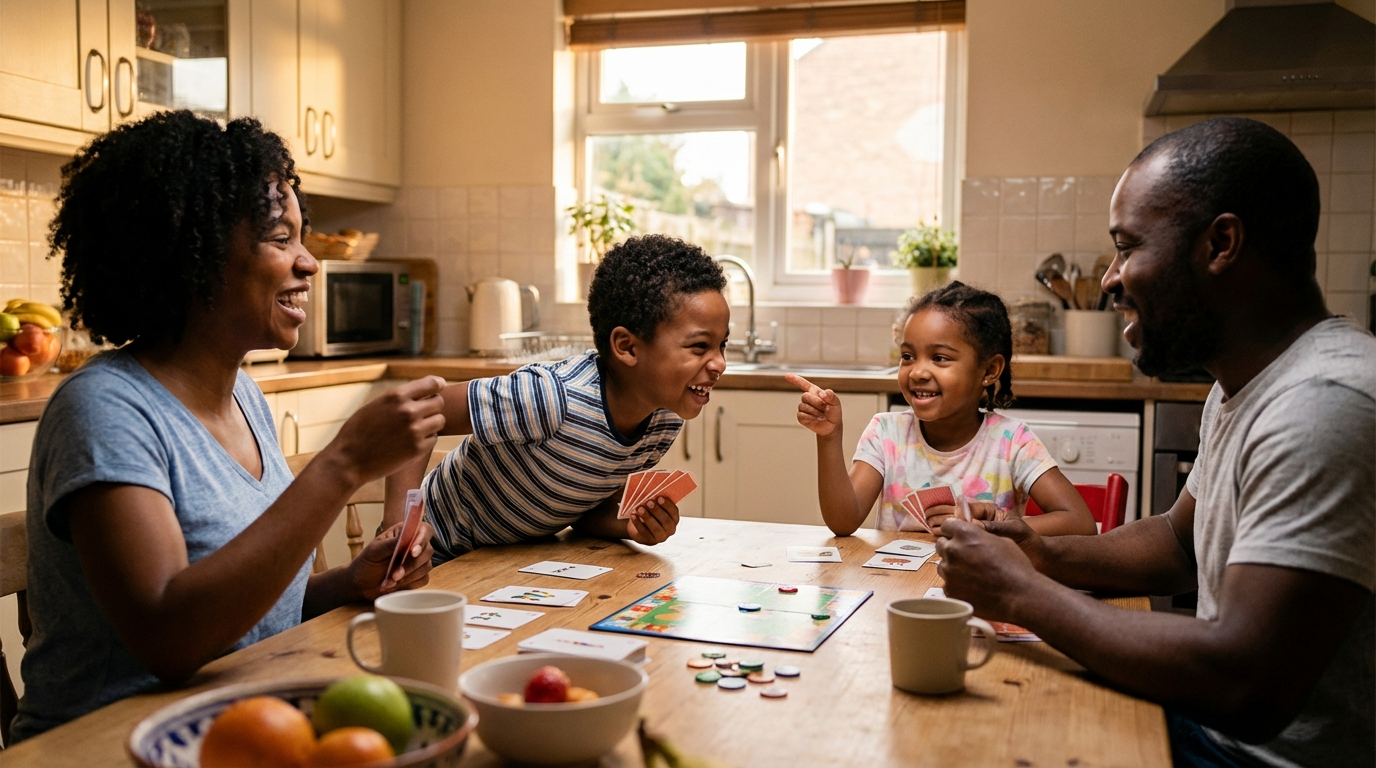
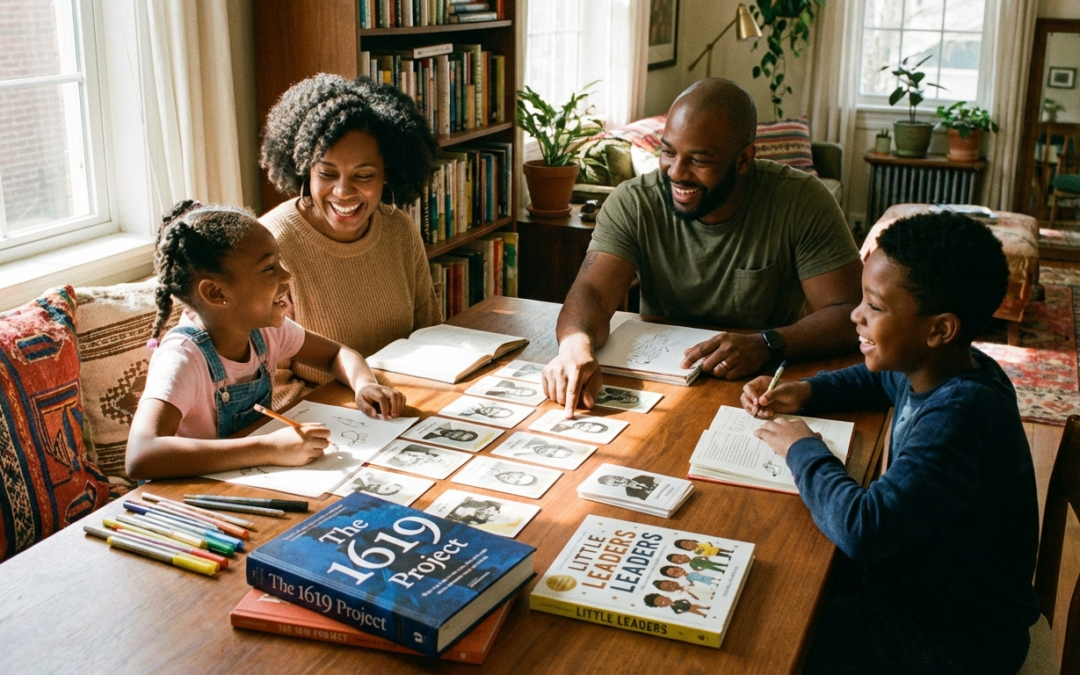
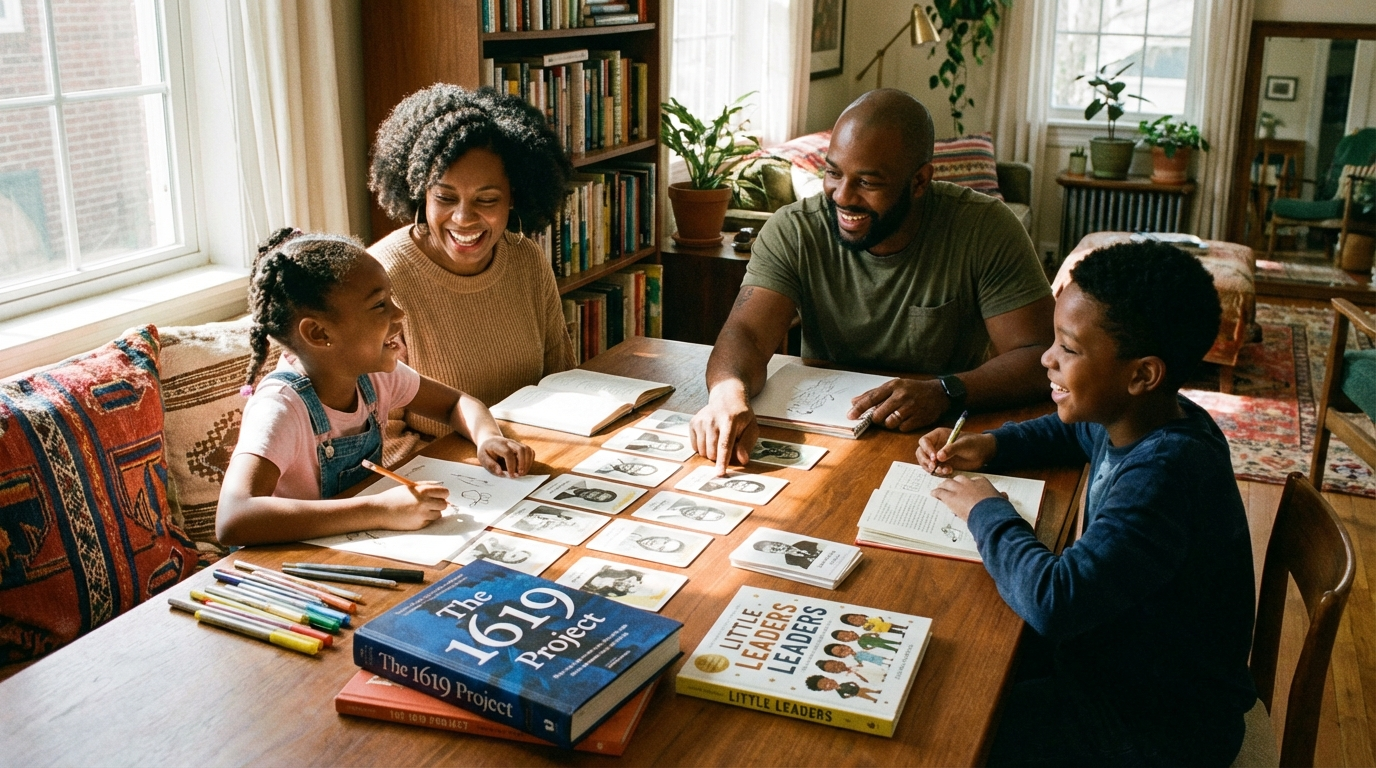
Pull out a deck of Black history flashcards and flip through them together. One person reads the clues on the back, everyone else guesses.
It sounds simple. But give it five minutes and watch what happens — kids get competitive, parents get humbled (“I didn’t know that!”), and the names start to stick.
Black History Flashcards → — 500,000+ sold because this works in real homes, not just ideal ones.
2. Breakfast With a Legend
Pick one historical figure each week. Print or pull up a photo. Put it on the table at breakfast.
One rule: say their name before anyone eats.
That’s it. Over time, those names become normal. They become part of your family’s conversation. Your child starts connecting present-day events to people they know by face and name.
3. Black History Bingo Night
Turn family game night into a history lesson nobody asked for — and everybody enjoyed.
Black history bingo boards cover figures, events, and facts. Teams. Prizes. The whole thing.
Works best with 4+ players and at least one grandparent who thinks they know everything. (They usually win.)
4. The “They Left This Out” Research Project
Challenge your older kids (10+): find one Black historical figure who is NOT in their school textbooks.
Research them. Write a paragraph. Present it at dinner.
This does two things: it teaches research skills, and it teaches your child to notice absences — which is one of the most important critical thinking skills they can have.
✊🏾 Join 500,000+ families keeping Black history alive at home.
Get tools, stories, and exclusive offers delivered to your inbox.
5. Watch a Documentary Together — Then Talk
Not just watch. Talk.
Pick one age-appropriate documentary about Black history. Watch it together. Then, before anyone gets up from the couch, each person says one thing they didn’t know before.
Some starting points:
- 13th (Netflix, ages 13+)
- The Black Panthers: Vanguard of the Revolution (ages 14+)
- John Lewis: Good Trouble (all ages)
- Hidden Figures (the film is great for kids 8+)
The conversation after is where the real learning happens.
6. Build a Family History Wall
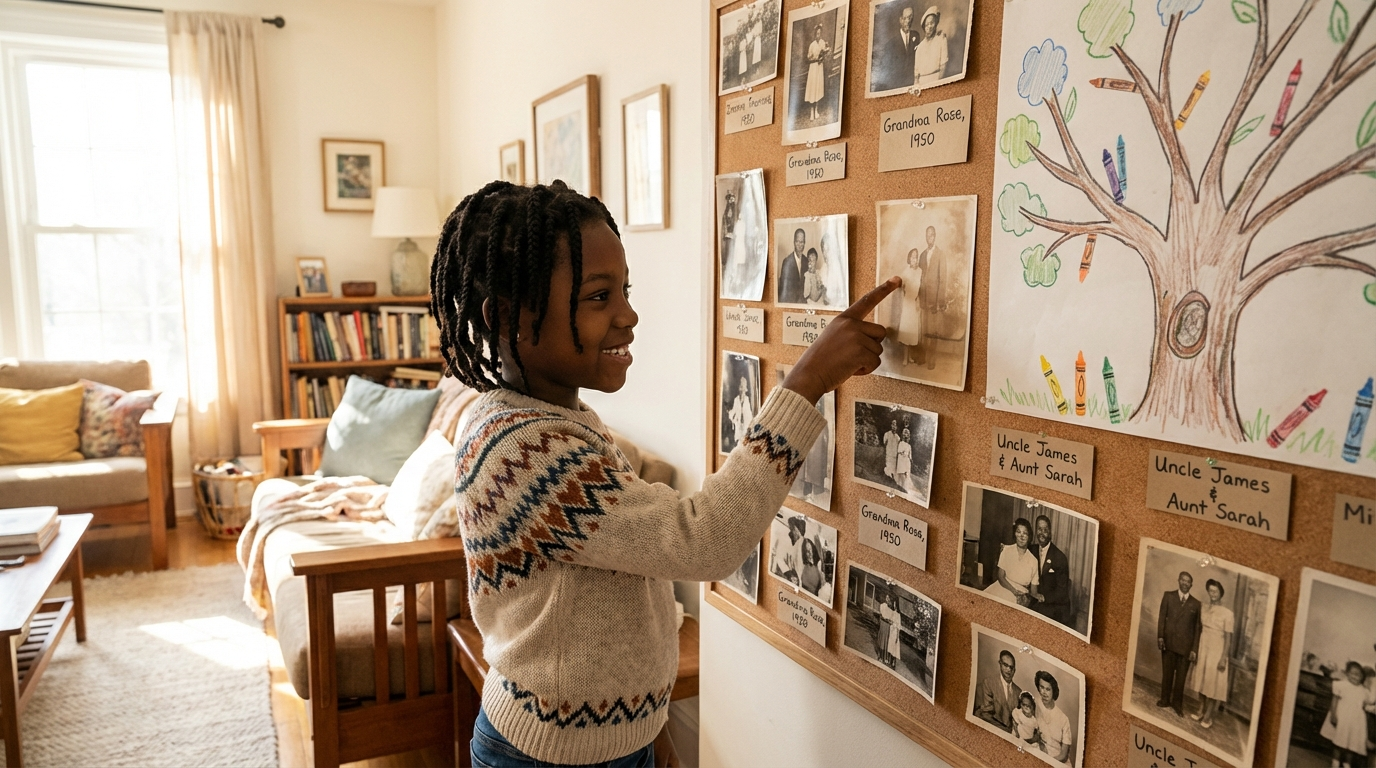
This one takes a Sunday afternoon and becomes a permanent fixture.
Get a corkboard or a section of wall. Start with what you know: names, places, photos, dates. Then ask your elders — parents, grandparents, great-aunts — to fill in the gaps.
You don’t need to trace back to Africa to make this powerful (though if you can, do it). Your family’s story is Black history. Make it visible.
7. Cook a Meal With a Story
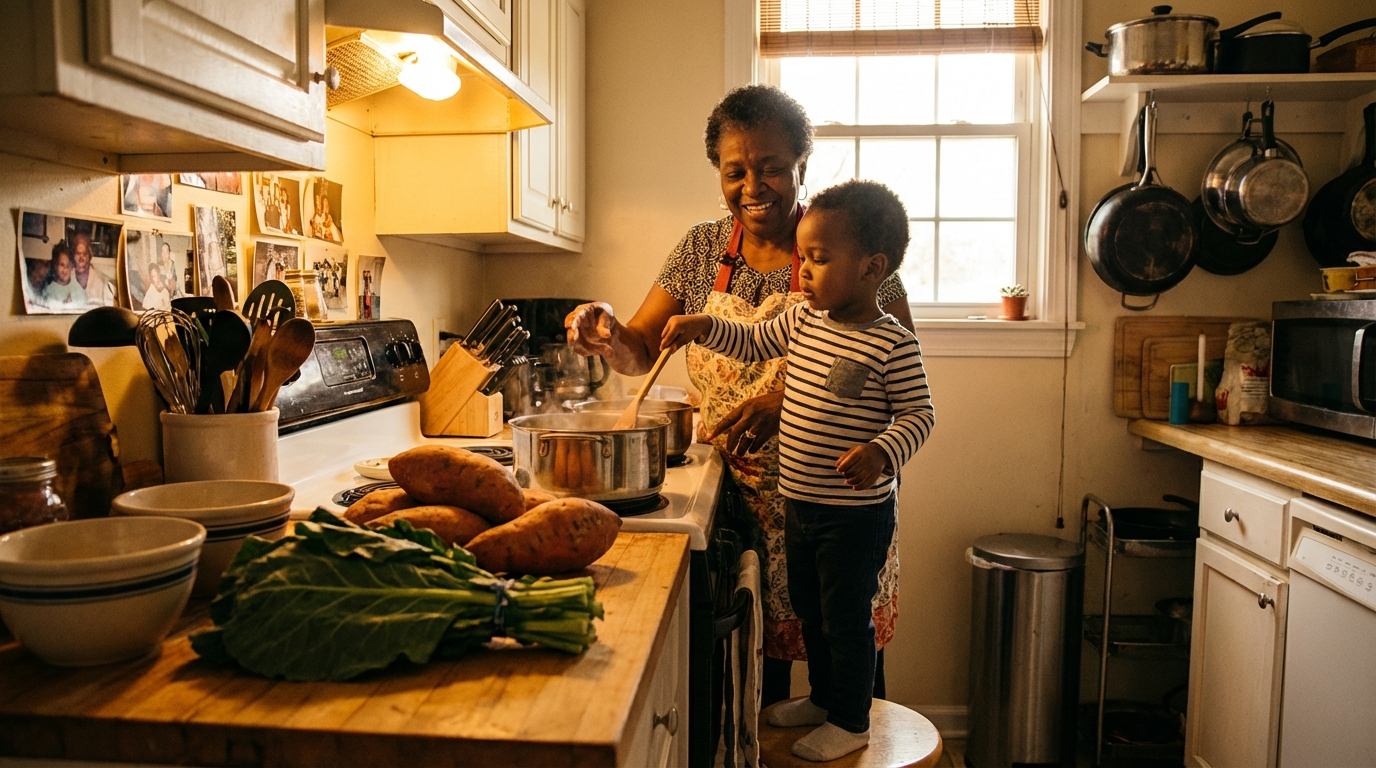
Every dish in Black American cooking has history behind it. Pick one this week.
Collard greens. Sweet potato pie. Red beans and rice. Gumbo. Fried catfish.
Cook it together. While you cook, talk about where it came from — African roots, slavery, Reconstruction, the Great Migration, Sunday traditions. The food becomes a doorway.
Bonus: find a dish connected to a specific region your family came from.
8. Read One Page a Night
Not a whole book. One page.
Find a book about Black history that’s right for your child’s age. Read one page aloud at bedtime. That’s it. One page a night is 30 pages a month, 365 pages a year.
Over a year, that’s the equivalent of a real education.
Some good starting points:
- Hand in Hand by Andrea Davis Pinkney (ages 6-10)
- X: A Novel by Ilyasah Shabazz (ages 12+)
- The Warmth of Other Suns by Isabel Wilkerson (teens and adults)
9. The “Name That Ancestor” Road Trip Game
On the next long car ride, take turns naming Black historical figures.
One rule: if you name someone the rest of the family knows, you get a point. If you name someone nobody else knows, you get three points.
This turns the car ride into a research motivation session. Kids will study before the next trip. Not because you asked them to — because they want to win.
10. Write a Letter to a Historical Figure
Pick a figure your child has been learning about. Have them write a letter — what would they say? What questions would they ask? What would they want them to know about the world today?
This is one of the most powerful exercises for older kids. It builds empathy, historical thinking, and writing skills all at once.
Keep the letters. Pull them out in five years.
11. Black History Trivia at Dinner
Every dinner has a trivia question. One question, one conversation.
Doesn’t need to be a quiz. Could be: “Who was the first Black woman to travel to space? What do you think it was like for her?”
The question starts the conversation. The conversation builds the knowledge. The knowledge builds the identity.
12. Let Your Child Teach You
Once a month, flip the script. Your child picks a historical figure, researches them, and teaches the family what they learned.
Give them a real audience: invite grandparents, siblings, cousins. Let them present.
This does something that passive learning can’t: it makes your child the authority. The expert. The keeper of the story.
That’s not just education. That’s identity.
The Point Isn’t the Activity — It’s the Habit
One activity won’t change anything.
But one activity, done regularly, in a home where Black history is normal — that changes everything.
You’re not trying to replicate school. You’re trying to build something school can’t: a child who knows who they are, where they come from, and why it matters.
That happens in the small moments. The breakfast table. The car ride. The bedtime page.
Ready to make it a habit? The Black History Flashcards are how over 500,000 families have made Black history part of their everyday routine. Not just February. Every day.
Urban Intellectuals has been putting Black history in Black homes since Freddie Taylor started with a single deck of cards. See the full collection →
Which of these activities will you try first? Share your plan in the comments — and tell us which ones your kids already love!
Don’t miss what matters.
Join the Urban Intellectuals family — history, culture, and tools for raising empowered Black children. Straight to your inbox.
📖 Also read: Why Volume 1 Black History Flashcards Still Matter in 2026

How to Talk to Your Black Child About Racism
There’s a conversation Black parents have been having for generations.
“The Talk.”
Most people think of it as one conversation — the serious one about police, about how to behave if you’re ever stopped. And yes, that conversation is real and necessary.
But there’s a bigger Talk happening. One that starts much earlier, in smaller moments, and never really ends.
How do you tell your child the truth about the world they live in — without loading them down with fear? How do you prepare them for racism without teaching them to see themselves as its victims?
This is the balance Black parents have been walking for 400 years. Here’s how to walk it well.

Why This Conversation Can’t Wait
Research is clear: children notice race much earlier than most parents expect.
By age 3, children are already aware of racial differences. By age 5, they’ve often internalized messages about which groups are “better” or “smarter” — messages coming from media, toys, books, and the world around them.
If you don’t name what they’re seeing, they fill the silence themselves. And the silence says: this isn’t something we talk about. Which teaches them that their racial identity is something to be ashamed of, or afraid of, or managed quietly.
That’s the opposite of what we want.
Naming it — at age-appropriate levels, calmly, honestly — is one of the most protective things you can do.
Ages 3–6: Lay the Foundation
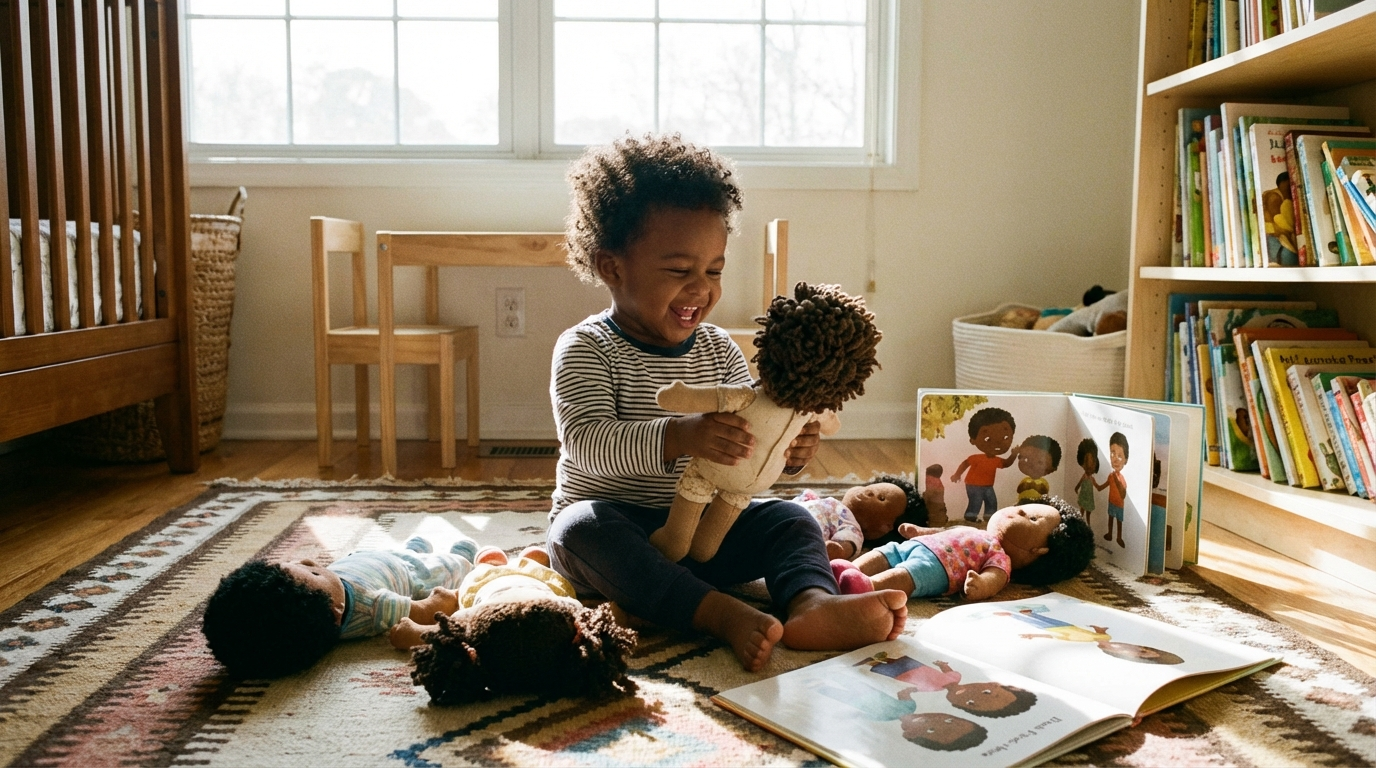
At this age, the goal isn’t to explain racism. It’s to give your child a strong, positive racial identity before the world has a chance to hand them a negative one.
What to do:
- Use correct language. Call things what they are. “She has brown skin like us.” “He has lighter skin.” Name it neutrally, early, and often.
- Fill their world with Black images. Books, toys, art on the wall, shows — representation at this age shapes what a child believes is normal and beautiful.
- Start with pride. Before you explain what people have tried to do to Black people, establish who Black people are. Warriors. Builders. Scientists. Storytellers. Artists. Royalty.
What to say when they ask “Why do people look different?”
“People come in all different shades, and every shade is beautiful. Our family has [describe your family’s skin tones]. Isn’t that something?”
Simple. Affirming. No fear loaded in.
Ages 7–10: Introduce the Reality, Not the Fear
At this age, children are starting to encounter the world more — school, friends, media. They may come home with questions. They may experience something confusing or hurtful.
What to do:
- Don’t wait for an incident to start the conversation. Have it proactively.
- Be honest that racism is real — and that it’s wrong, not normal. This distinction matters. You’re not teaching them that the world is dangerous. You’re teaching them that some people do unfair things, and that’s their failure, not yours.
- Introduce history as context, not horror. When you explain that Black people were enslaved, that we fought for rights, that we are still fighting — frame it as proof of strength, not just a catalog of suffering.
What to say:
“Sometimes people treat other people unfairly because of their skin color. That’s called racism. It’s wrong, and it’s not your fault if it ever happens to you. It says nothing true about who you are.”
And follow it with:
“Let me tell you about some of the people who fought back and changed things. Because that’s your history too.”
✊🏾 Join 500,000+ families keeping Black history alive at home.
Get tools, stories, and exclusive offers delivered to your inbox.
Ages 11–14: Get Into the Hard Conversations
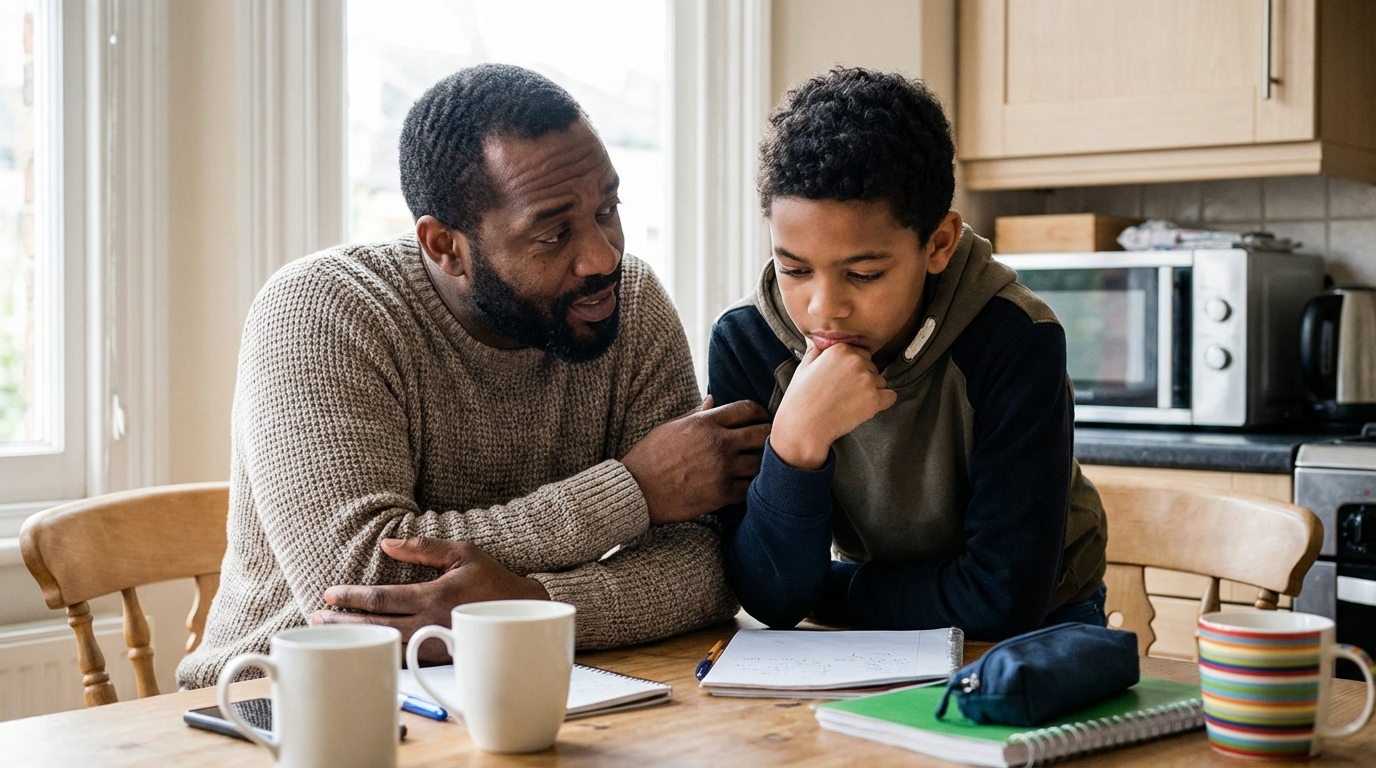
Middle school is where things get real. Your child is developing their identity, encountering more complex social dynamics, and probably already seeing things on social media you don’t know about.
This is the age for the deeper version of the Talk.
What to do:
- Talk about what racism looks like beyond individual acts — systemic, institutional, structural. Help them see the patterns, not just the incidents.
- Give them language. “Microaggression.” “Code-switching.” “Double standard.” Naming something gives you power over it.
- Teach them to trust their gut. If something feels wrong, it probably is. They don’t need to prove it to a committee to know what they experienced.
- Talk about The Talk specifically — what to do if they’re ever stopped by police, how to protect themselves while staying alive. This conversation is not optional.
Be real with them:
“The world is not fair to Black people in ways that are not your fault. I’m telling you this not to scare you, but because you deserve to understand what you’re navigating — and because knowing it makes you more powerful, not less.”
Ages 15–18: Raise a Critical Thinker
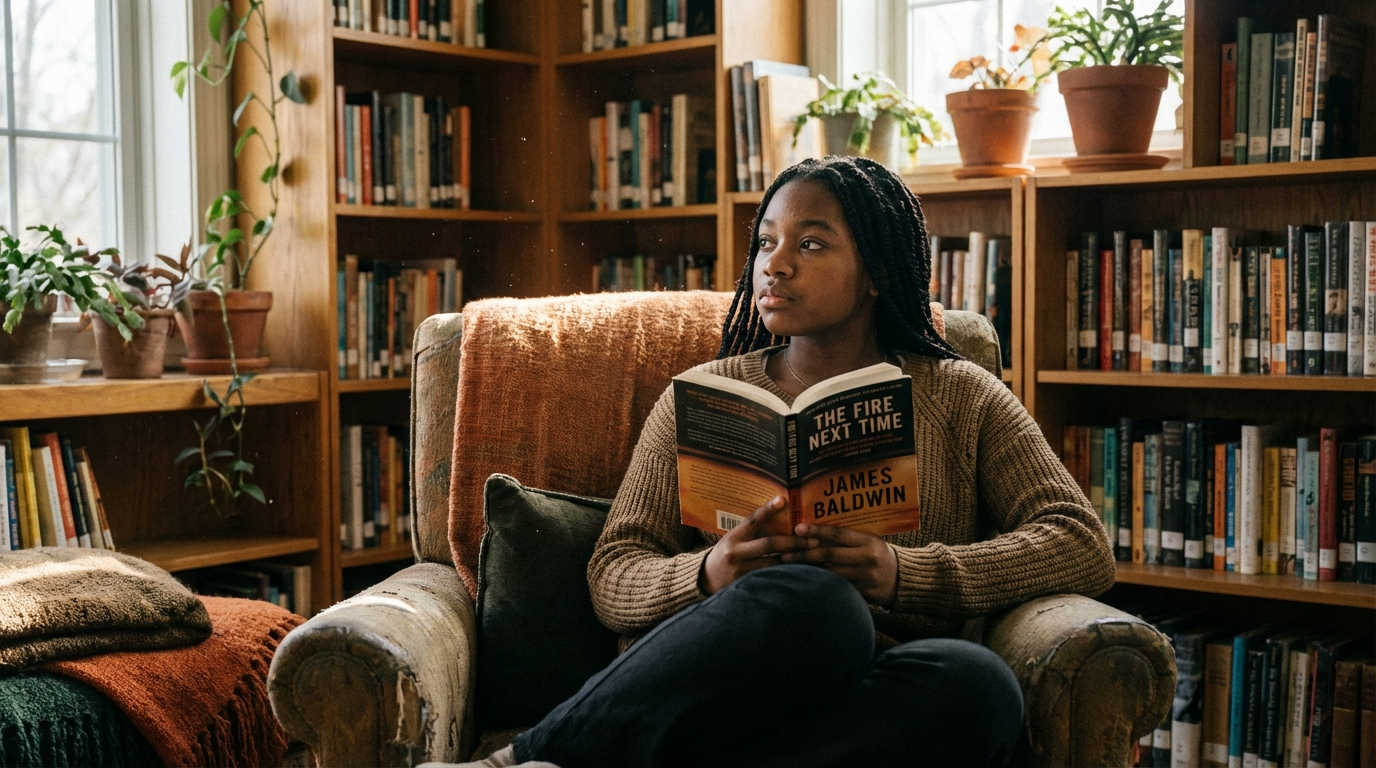
By high school, your child is encountering history class, social media, peer debates, and their own experiences all at once. Your job shifts from explainer to thinking partner.
What to do:
- Ask more than you tell. “What do you think about what happened?” “How does that make you feel?” “What do you know about the history behind that?”
- Introduce them to Black thinkers, writers, and activists — not as assigned reading, but as people who grappled with the same questions they’re grappling with now. James Baldwin. bell hooks. Ida B. Wells. Nikole Hannah-Jones.
- Talk about anger — how to hold it, how to use it, how not to let it use them.
- Let them know they have a community. This isn’t just their fight. It’s ours.
The Conversation That Never Ends
Here’s the truth: this isn’t a Talk. It’s a posture.
It’s the way you frame news stories at dinner. The books on the shelf. The names you drop in conversation. The questions you ask when they come home from school. The calm, grounded certainty you project that says: you know who you are, and that’s not up for debate.
The parents who do this best don’t have one big conversation. They have a thousand small ones. As they get older, those conversations go deeper — including teaching them to spot covert racism. Read: Teaching Your Kids to See the Mask Before It Slips.
The Black History Flashcards are one of the simplest tools for making those small conversations happen. One card at breakfast. A name on the way to school. “Do you know who this is?” — and suddenly you’re in it.
Over 500,000 families have made it part of their routine. Because the Talk isn’t a one-time event. It’s a practice.
You’re Not Doing This Alone
Black parents have been preparing their children for this world for centuries. The methods have changed. The love behind them hasn’t.
You’re part of a long line of people who chose to tell the truth, equip their children with history, and trust them to carry it.
That lineage is worth something. Pass it on.
Urban Intellectuals was founded to put that history in Black homes — in hands that will actually use it. Browse the full collection →
What age did you start having “the Talk” with your children? What worked? What didn’t? Share your experience below.
Related reading: What Really Happened to Zelalem Eshetu Ewnetu: The Black Engineer Killed by LA Sheriffs — a reminder of exactly why these conversations can’t wait.
Don’t miss what matters.
Join the Urban Intellectuals family — history, culture, and tools for raising empowered Black children. Straight to your inbox.
Related: Druski Isn’t Robinson: What the Difference Tells Us About How We Raise Our Kids
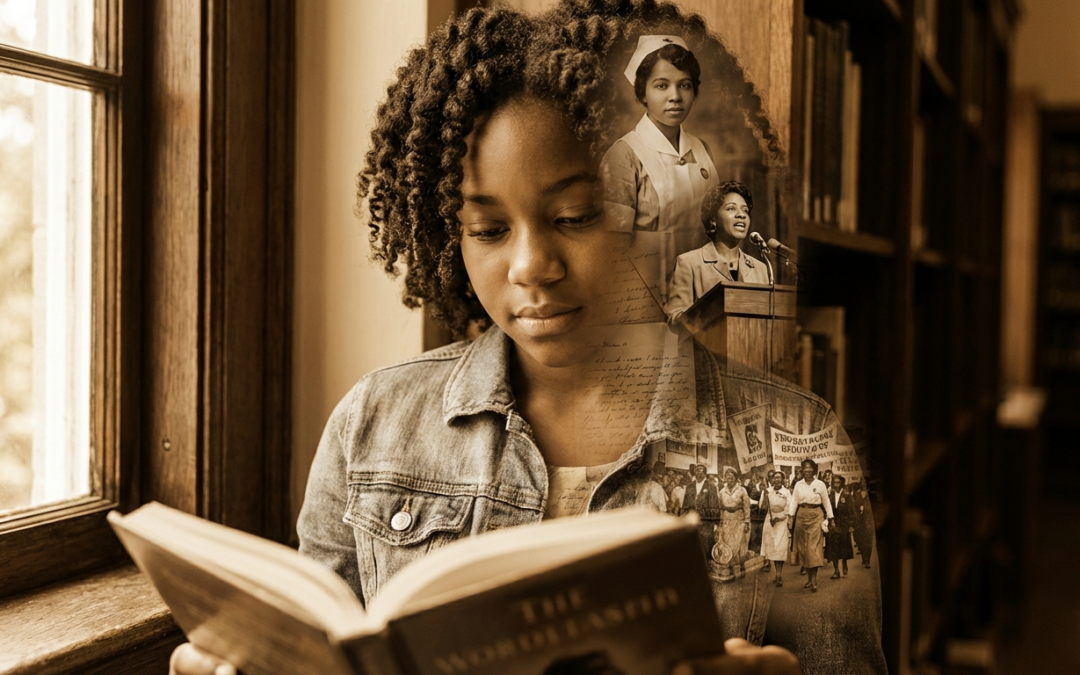
10 Black Women Who Changed History That Your Kids Should Know
Quick — name five Black women from history.
If you said Harriet Tubman, Rosa Parks, Maya Angelou, and then started stalling… you’re not alone.
And that’s exactly the problem.
The contributions of Black women have been systematically erased, minimized, or attributed to someone else for centuries. Women’s History Month is winding down, but the urgency of teaching our children these stories doesn’t end in March.
Here are 10 Black women every child — and every adult — should know by name.
1. Mary McLeod Bethune — The Woman Who Built a University From Nothing
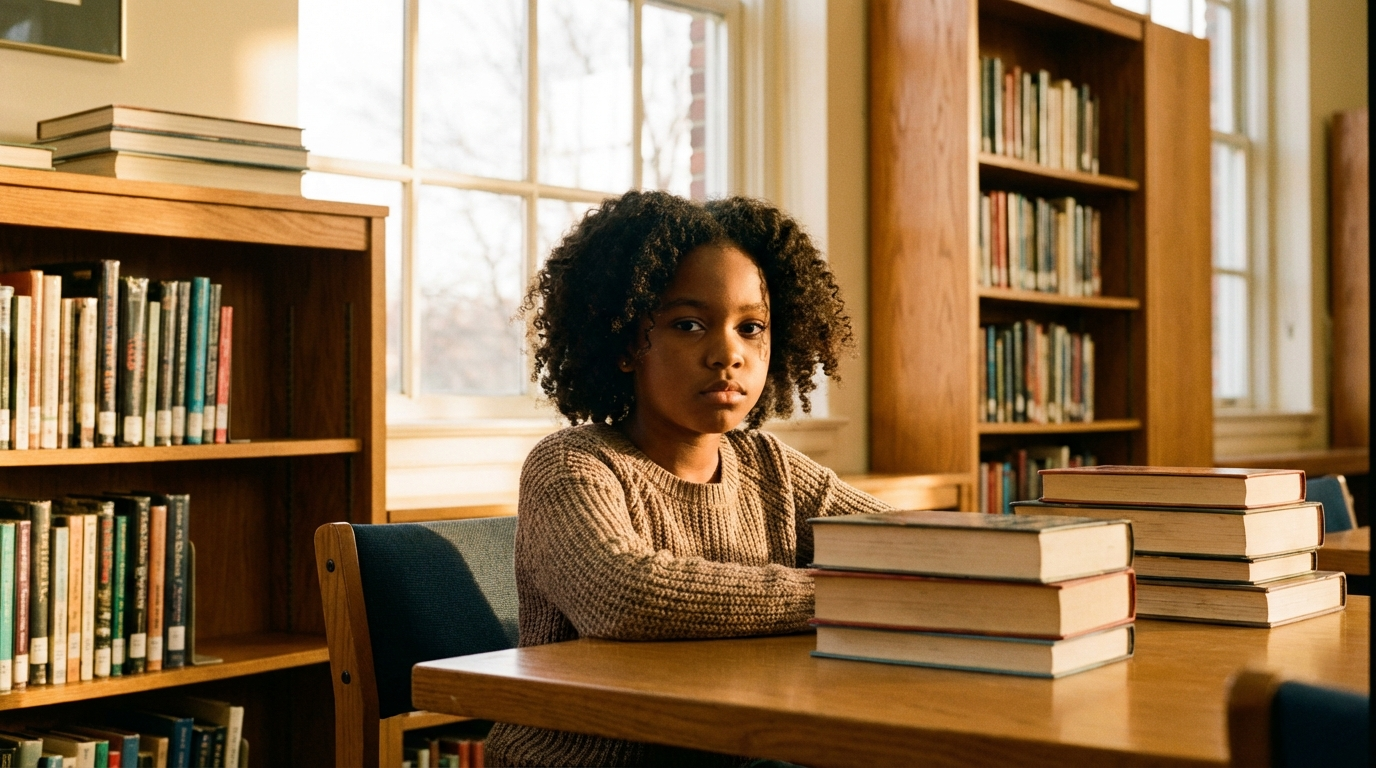
In 1904, Mary McLeod Bethune opened a school for Black girls in Daytona Beach, Florida with $1.50, five students, and crates for desks.
That school became Bethune-Cookman University.
She went on to advise President Franklin D. Roosevelt and became the highest-ranking Black woman in government at the time. She didn’t wait for permission. She didn’t wait for funding. She started with what she had and built an empire of education.
2. Madam C.J. Walker — America’s First Self-Made Female Millionaire
Before Oprah. Before Rihanna. There was Sarah Breedlove — better known as Madam C.J. Walker.
Born to formerly enslaved parents in 1867, she built a hair care empire that made her the first self-made female millionaire in American history. She employed thousands of Black women and used her wealth to fund anti-lynching campaigns and civil rights organizations.
She didn’t just break the glass ceiling. She built her own building.
3. Fannie Lou Hamer — “I’m Sick and Tired of Being Sick and Tired”
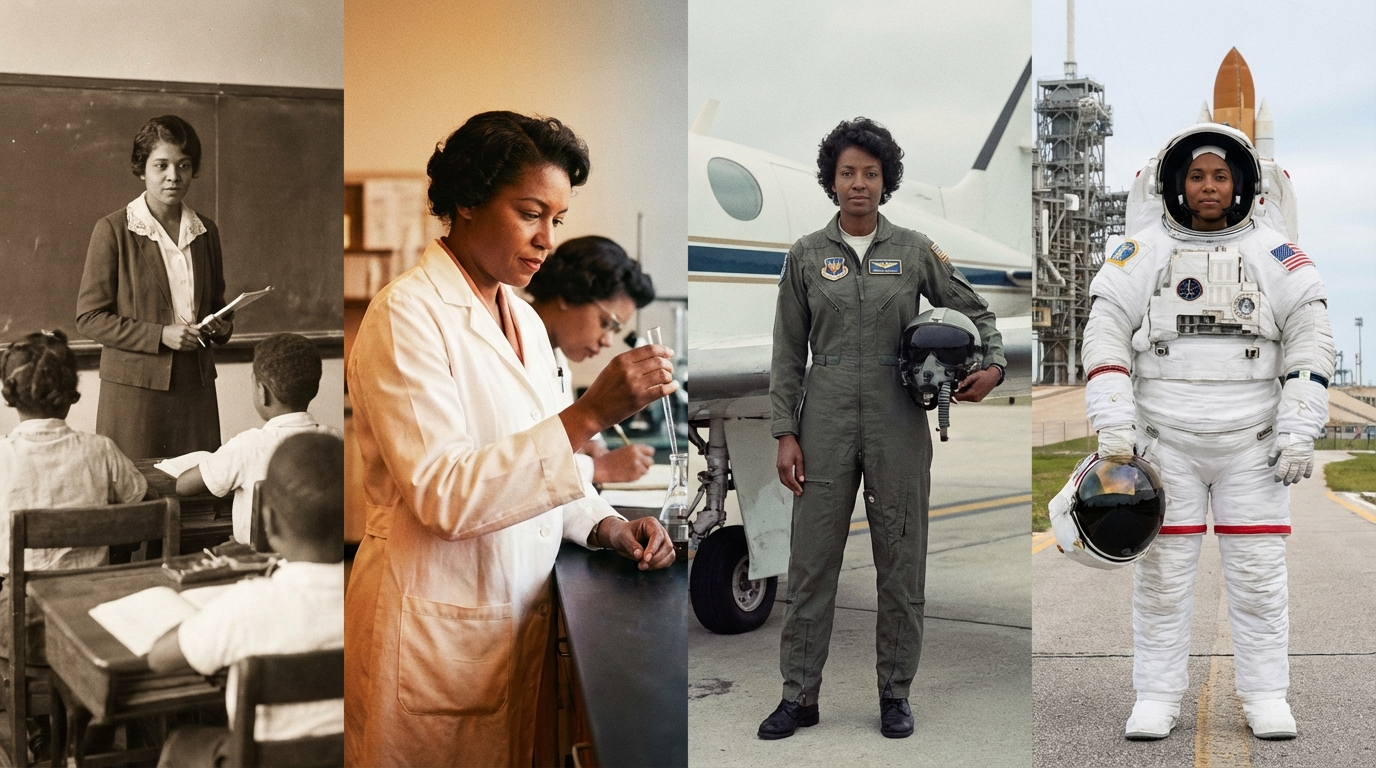
Fannie Lou Hamer was a sharecropper in Mississippi who was beaten nearly to death for trying to register to vote. She didn’t stop. She co-founded the Mississippi Freedom Democratic Party and challenged the all-white delegation at the 1964 Democratic National Convention.
Her testimony was so powerful that President Lyndon Johnson called an emergency press conference to pull TV coverage away from her. He was scared of a sharecropper with the truth. That tells you everything.
4. Ida B. Wells — The Journalist Who Fought Lynching With Data
Ida B. Wells didn’t just write about the horrors of lynching — she investigated them. She traveled across the South, documented cases, published the data, and forced the world to confront what America wanted to hide.
She was exiled from Memphis after her newspaper office was destroyed by a white mob. She kept writing. She kept fighting. She co-founded the NAACP and never stopped holding this country accountable.
5. Katherine Johnson — The Mathematician Who Sent America to Space
You might know her from the movie Hidden Figures. But the real story is even more remarkable.
Katherine Johnson calculated the trajectory for America’s first human spaceflight. When NASA started using computers, astronaut John Glenn refused to fly until Katherine personally verified the numbers. She was that good.
She worked at NASA for 33 years and received the Presidential Medal of Freedom in 2015.
✊🏾 Join 500,000+ families keeping Black history alive at home.
Get tools, stories, and exclusive offers delivered to your inbox.
6. Shirley Chisholm — “Unbought and Unbossed”
In 1968, Shirley Chisholm became the first Black woman elected to Congress. In 1972, she became the first Black candidate for a major party’s presidential nomination.
She was told to wait her turn. She ran anyway. She was told she couldn’t win. She ran anyway. She opened doors that every Black woman in politics has walked through since.
7. Mary Bowser — The Spy in the Confederate White House
Mary Bowser was an enslaved woman who was freed and then voluntarily went back into the Confederate White House as a spy for the Union.
She had a photographic memory. She read documents off Jefferson Davis’s desk and passed intelligence to the Union Army. She was one of the most valuable spies in the Civil War — and most people have never heard her name.
8. Bessie Coleman — The First Black Woman to Earn a Pilot’s License
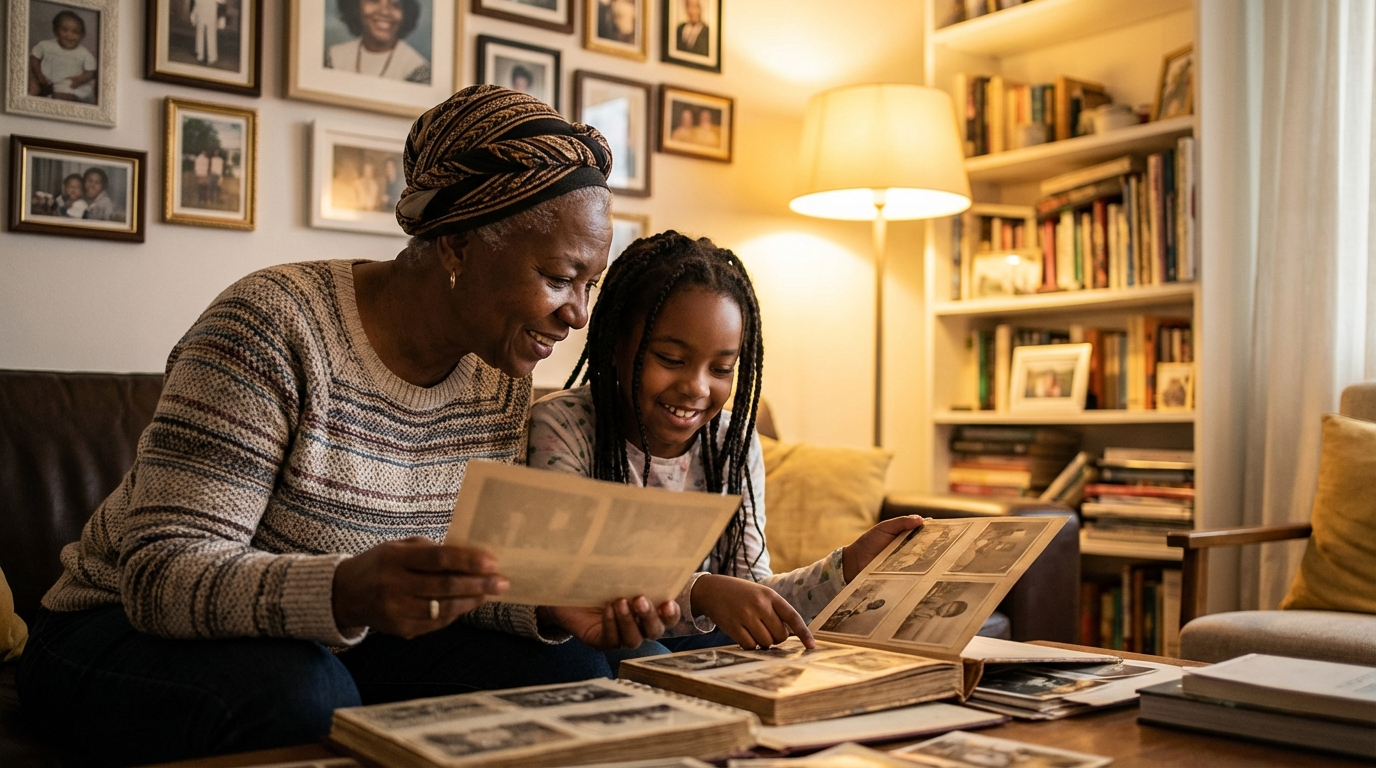
No American flight school would accept a Black woman in 1920. So Bessie Coleman learned French and moved to France to get her license.
She became the first Black woman — and the first Native American woman — to hold a pilot’s license. She performed in air shows across America, refusing to perform at venues that segregated their entrances. She used her platform to fight, even while flying.
9. Dorothy Height — The Godmother of the Civil Rights Movement
Dorothy Height stood on the stage at the March on Washington in 1963. She was the only woman on the platform — and she wasn’t allowed to speak.
She spent 40 years leading the National Council of Negro Women and worked alongside every major civil rights leader of the 20th century. She fought for racial justice and women’s rights simultaneously, refusing to choose between her identities.
10. Claudette Colvin — The Teenager Who Refused to Move Before Rosa Parks
Nine months before Rosa Parks, a 15-year-old girl named Claudette Colvin refused to give up her seat on a Montgomery bus. She was arrested, handcuffed, and dragged off the bus.
Civil rights leaders chose Rosa Parks as the face of the boycott because they thought a teenager wouldn’t hold up to public scrutiny. Claudette’s courage started the fire. She deserves to be remembered.
Why These Stories Matter Right Now
With DEI rollbacks gutting school curricula and book bans accelerating across the country, our daughters need these stories more than ever.
Not as footnotes. Not as “fun facts” during Women’s History Month. As the foundation of how they see themselves.
Our Women’s Edition Black History Flashcards feature dozens of women like these — the ones the textbooks forgot. Every card is a conversation starter. Every conversation builds identity.
Because a Black girl who knows that Bessie Coleman moved to France to chase her dream, that Mary Bowser outsmarted the Confederacy from the inside, that Fannie Lou Hamer stared down the President of the United States — that girl walks differently through the world.
Which Black woman from history inspires you the most? Tell us in the comments — and share this with a young girl who needs to see it.
Love, peace, and power to the people. ✊🏾
Don’t miss what matters.
Join the Urban Intellectuals family — history, culture, and tools for raising empowered Black children. Straight to your inbox.
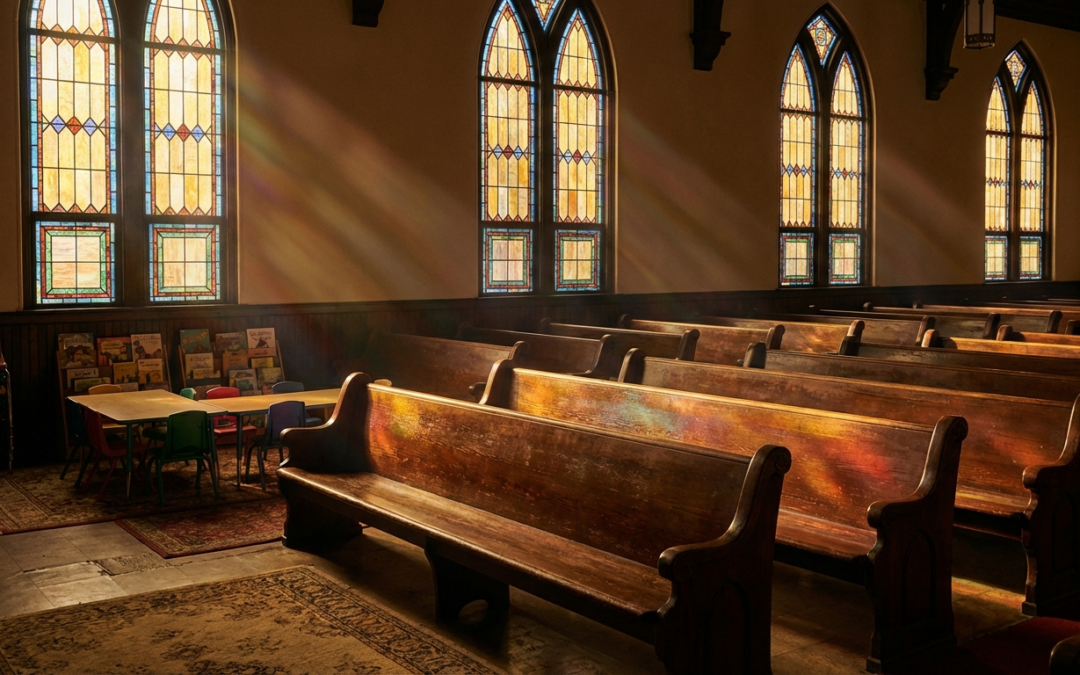
What the Black Church Owes Black Children
This one’s going to ruffle some feathers. And I’m okay with that.
The Black church has been the backbone of our community for centuries. It sheltered us during slavery. It organized us during the Civil Rights Movement. It fed our families when nobody else would.
But let’s have an honest conversation about what it’s doing right now — for our children.
The Foundation We Built On
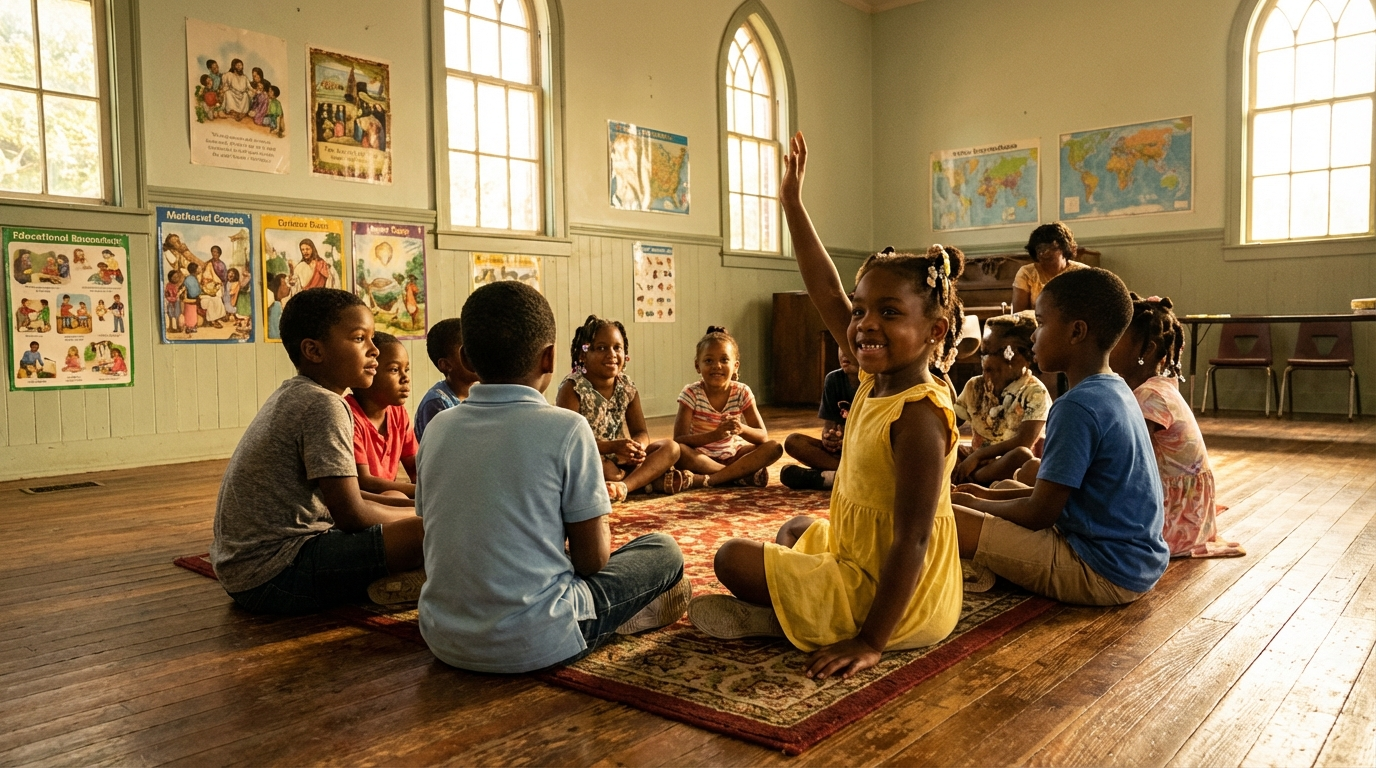
Before we get into the hard questions, let’s give credit where it’s earned.
The Black church gave us more than Sunday sermons. It gave us schools when the state refused to educate us. It gave us banks when no one would lend to us. It gave us political power when the law said we had none.
Fannie Lou Hamer organized from the church. Martin Luther King Jr. preached from the pulpit before he marched in the streets. The church wasn’t just where we worshipped — it was where we strategized, healed, and rebuilt.
That legacy is real. And it matters.
But Here’s the Question Nobody Wants to Ask
What is the Black church teaching our children about who they are?
Not spiritually. I’m talking historically. Culturally. Practically.
Because when a Black child sits in Sunday School and the only history they learn is Biblical history — with no connection to African civilizations, Black inventors, or the architects of the very freedom they enjoy — we’re leaving something on the table.
Something important.
The Education Gap in the Pew
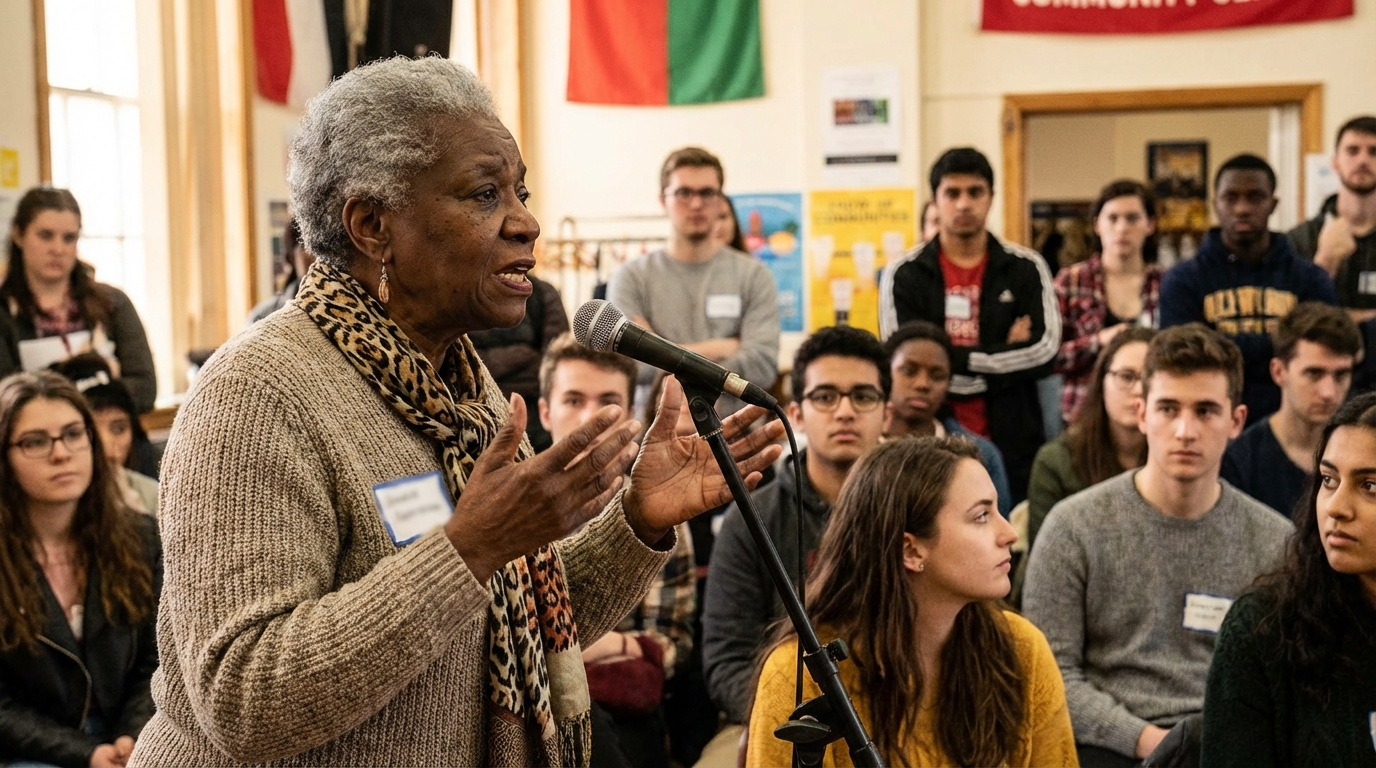
Think about it. The average Black child spends 2-3 hours in church every Sunday. That’s 100+ hours a year. What if just 15 minutes of that time was dedicated to Black history?
Not instead of scripture. Alongside it.
What if every Sunday School opened with a Black history moment? What if youth groups studied the Moors alongside Moses? What if vacation Bible school included a week on the kingdoms of Mali, Songhai, and Aksum?
Our churches have the attention of our children. The question is what we’re doing with it.
✊🏾 Join 500,000+ families keeping Black history alive at home.
Get tools, stories, and exclusive offers delivered to your inbox.
What Some Churches Are Getting Right
I want to be fair — some churches are already doing this work. I’ve seen congregations in Atlanta, Chicago, and Detroit that run afterschool programs teaching Black history, host cultural festivals, and stock their libraries with books that reflect our children.
Those churches understand something crucial: spiritual formation and cultural formation aren’t competing priorities. They’re partners.
When a child knows that the Ethiopian eunuch in Acts 8 came from one of the most powerful civilizations on earth — that changes how they read the text. That’s not secular intrusion. That’s context. And context is everything.
The Accountability Conversation
Here’s where I might lose some of you. But stay with me.
Churches receive billions in donations from the Black community every year. Billions. And a significant portion of our community’s wealth flows through those offering plates.
So it’s fair to ask: how much of that is being reinvested in educating our children? How many churches run tutoring programs? How many have libraries? How many teach financial literacy, African history, or practical life skills?
Some do. Many don’t. And the ones that don’t need to hear this: our children deserve more than a fish fry and an Easter play.
They deserve to know who they are.
This Isn’t Anti-Church — It’s Pro-Child
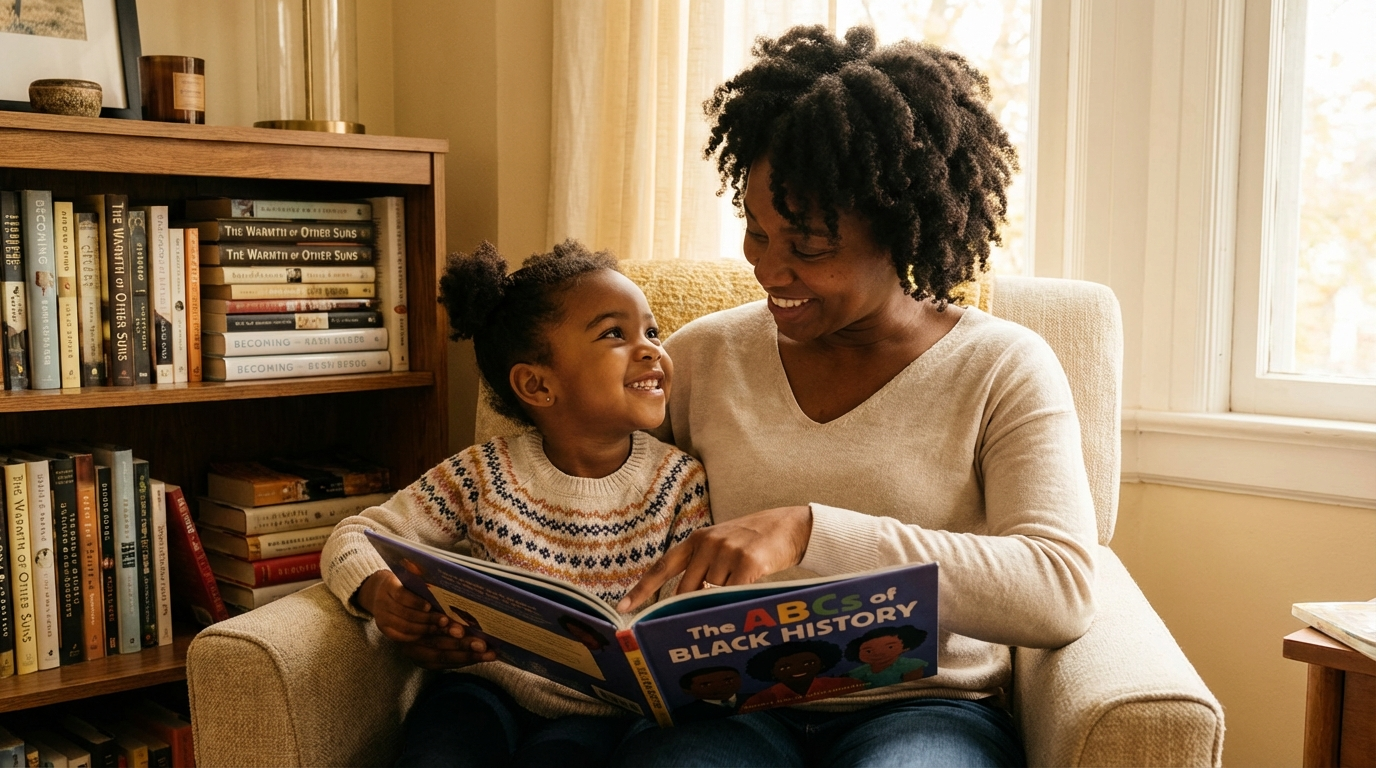
Let me be crystal clear. I’m not attacking the Black church. I’m challenging it to live up to its own legacy.
The same institution that built schools for freed enslaved people in the 1860s can absolutely teach Black history in 2026. The same church that organized voter registration drives can organize reading programs. The infrastructure is there. The congregation is there. The children are there.
The only question is the will.
What You Can Do Right Now
You don’t have to wait for your church to catch up. Start at home.
Put Black History Flashcards on your coffee table. Pull one out before family devotion. Let your kids learn about Mansa Musa on Monday and Moses on Sunday.
Talk to your pastor. Suggest a monthly Black history moment during announcements. Donate a set of flashcards to the youth ministry. Start small — but start.
Our children’s education is too important to outsource entirely to any single institution — whether that’s the school system or the sanctuary.
Does your church teach Black history? What do you wish they’d do differently? I want to hear your experience.
Love, peace, and power to the people. ✊🏾
Don’t miss what matters.
Join the Urban Intellectuals family — history, culture, and tools for raising empowered Black children. Straight to your inbox.
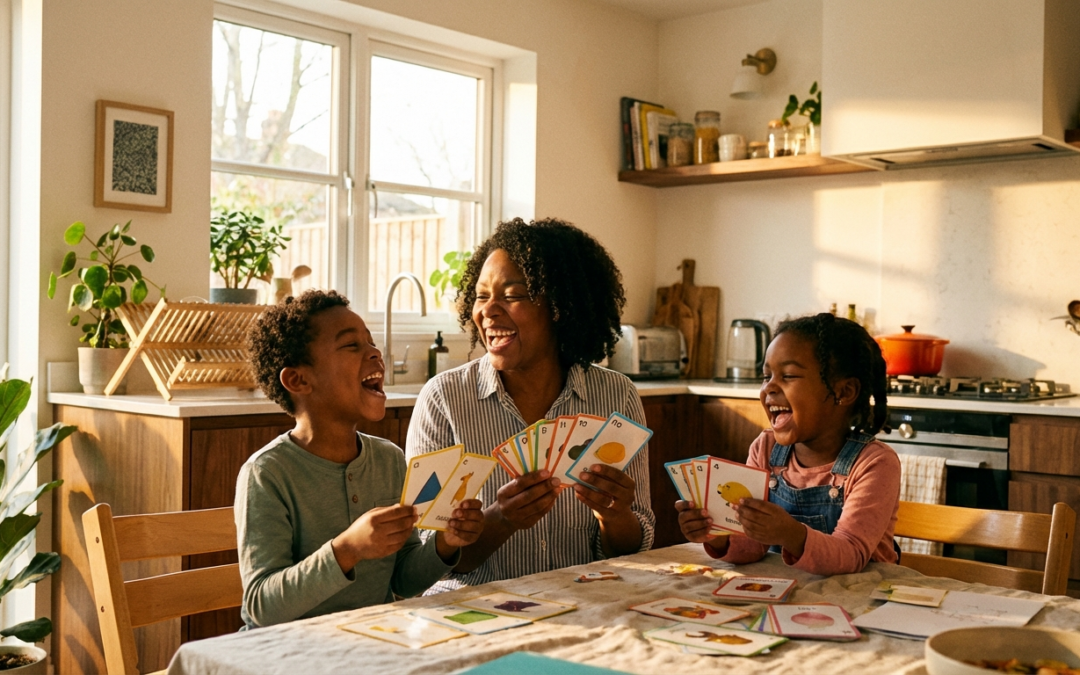
Why Every Black Family Needs a Set of Black History Flashcards
Let me ask you something.
When your child comes home from school and tells you what they learned about Black history — what do they say?
Martin Luther King had a dream. Rosa Parks sat on a bus. Harriet Tubman ran north. Maybe they throw in George Washington Carver and the peanut, if you’re lucky.
That’s not Black history. That’s a highlight reel designed to make everybody comfortable.
The Problem Isn’t What They Teach — It’s What They Leave Out
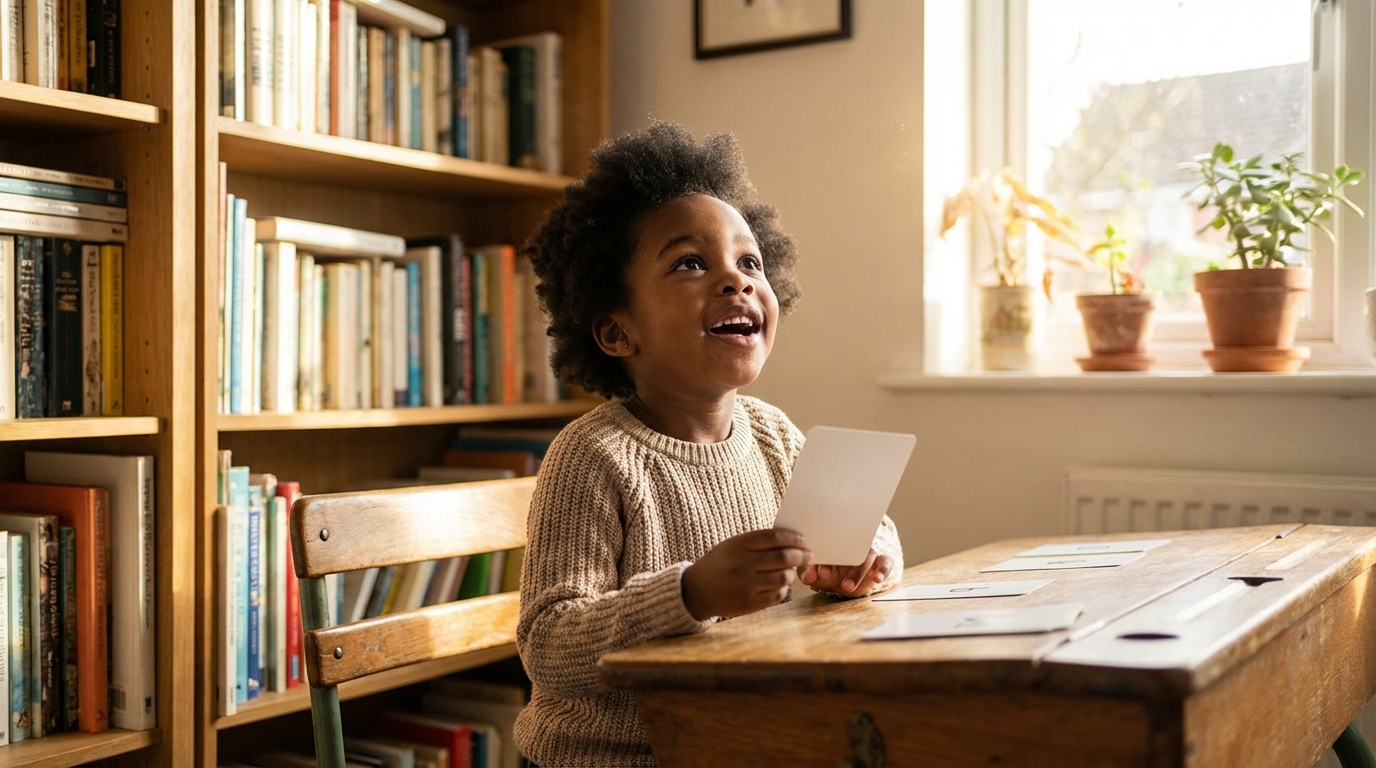
Here’s what your child probably didn’t learn this year:
That Lewis Latimer made Edison’s lightbulb actually work. That Dr. Charles Drew revolutionized blood banks and then was turned away from the very hospitals his work saved. That Mansa Musa was the wealthiest person in human history — and he was African.
These aren’t obscure facts for history buffs. This is the foundation. And when our kids don’t have it, they walk through the world thinking Black history started with slavery and ended with the Civil Rights Movement.
That’s not a gap. That’s an erasure.
Why Flashcards Hit Different
You might be thinking — flashcards? That’s your big solution?
Hear me out.
There’s something powerful about a physical object you can hold, flip through, and pass around the dinner table. It’s not a textbook nobody opens. It’s not a YouTube video that autoplays into something else. It’s a tool that starts conversations.
When a seven-year-old pulls a card and asks, “Who’s Garrett Morgan?” — that’s a door opening. And you get to walk through it together.
That’s what flashcards do. They make Black history tactile. Shareable. Part of your daily life instead of a once-a-year performance.
The Dinner Table Effect
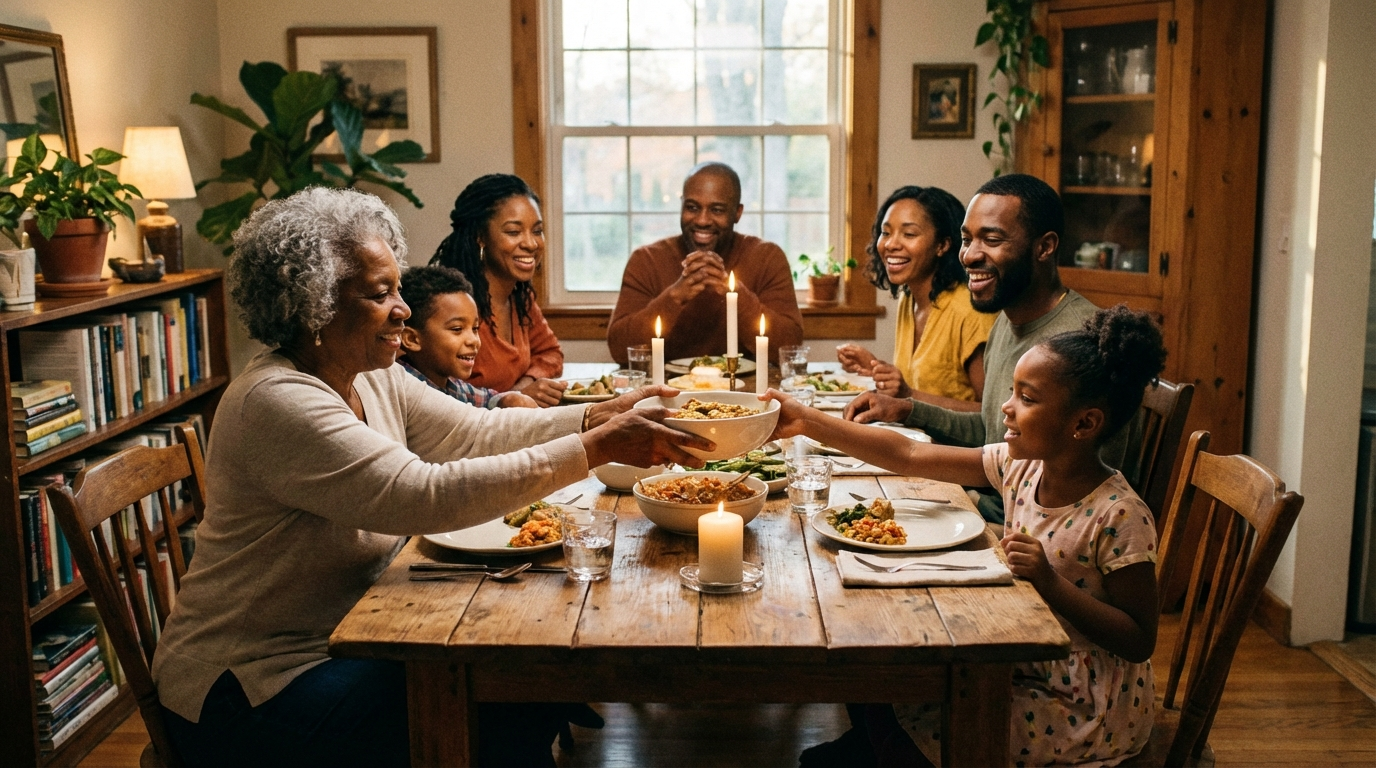
We’ve heard from thousands of families who use our Black History Flashcards and the same story keeps coming back:
“We pull a card every night at dinner.”
One card. One conversation. One new hero your child didn’t know existed.
Over a month, that’s 30 figures. Over a year? Your child knows more Black history than most adults. Not because you sat them down for a lecture, but because you made it part of how your family lives.
That’s not education. That’s culture.
✊🏾 Join 500,000+ families keeping Black history alive at home.
Get tools, stories, and exclusive offers delivered to your inbox.
It’s Not Just for Kids
Let’s keep it real — most of us don’t know our own history as deeply as we should. And that’s not our fault. The system wasn’t designed to teach it to us.
These flashcards aren’t just for your children. They’re for you. For your parents. For the uncle who thinks he knows everything but has never heard of Mary Bowser, the enslaved woman who spied for the Union from inside the Confederate White House.
Every card is a revelation. Every conversation is a reclamation.
What Schools Won’t Do, We Have To

With DEI programs being gutted across the country and school boards pulling books from libraries, the message is clear: they are not going to teach our children who they are.
That was never their job anyway. It’s ours.
And the good news is — you don’t need a curriculum. You don’t need a teaching degree. You need a deck of cards and a willingness to start the conversation.
That’s it.
This Is About More Than Facts
When a Black child learns that someone who looked like them invented, discovered, ruled, or resisted — it changes how they see themselves. It’s not just history. It’s identity.
And in a world that constantly tells our children what they can’t do, what they aren’t, what they didn’t build — handing them a stack of evidence to the contrary is one of the most powerful things you can do as a parent.
Start Tonight
Grab a deck. Pull a card at dinner. Ask your kids what they think. Watch what happens.
You’ll be surprised how fast a simple flashcard turns into a two-hour conversation about legacy, courage, and what it really means to be Black in this world.
Check out the full collection here.
What Black history figure do you wish you’d learned about sooner? Hit the comments — I want to hear it.
📖 You might also like: Why People Are Waking Up to Freddie Taylor’s 50 Truths They Tried to Erase
📖 You might also like: Start Here: What Is Urban Intellectuals and Who Is It For?
📖 You might also like: Meet Freddie Taylor: The Man Behind Urban Intellectuals and Why He Built It
Love, peace, and power to the people. ✊🏾
Don’t miss what matters.
Join the Urban Intellectuals family — history, culture, and tools for raising empowered Black children. Straight to your inbox.
📖 Also read: Why Volume 1 Black History Flashcards Still Matter in 2026


 Flashcards
 Games
Games Apparel & Homeware
 Travel
 Schools
 Memberships
 Sankofa Club (Children)
 About Us