

<< Go back to Main Page
Tecumseh
1
Quick Summary
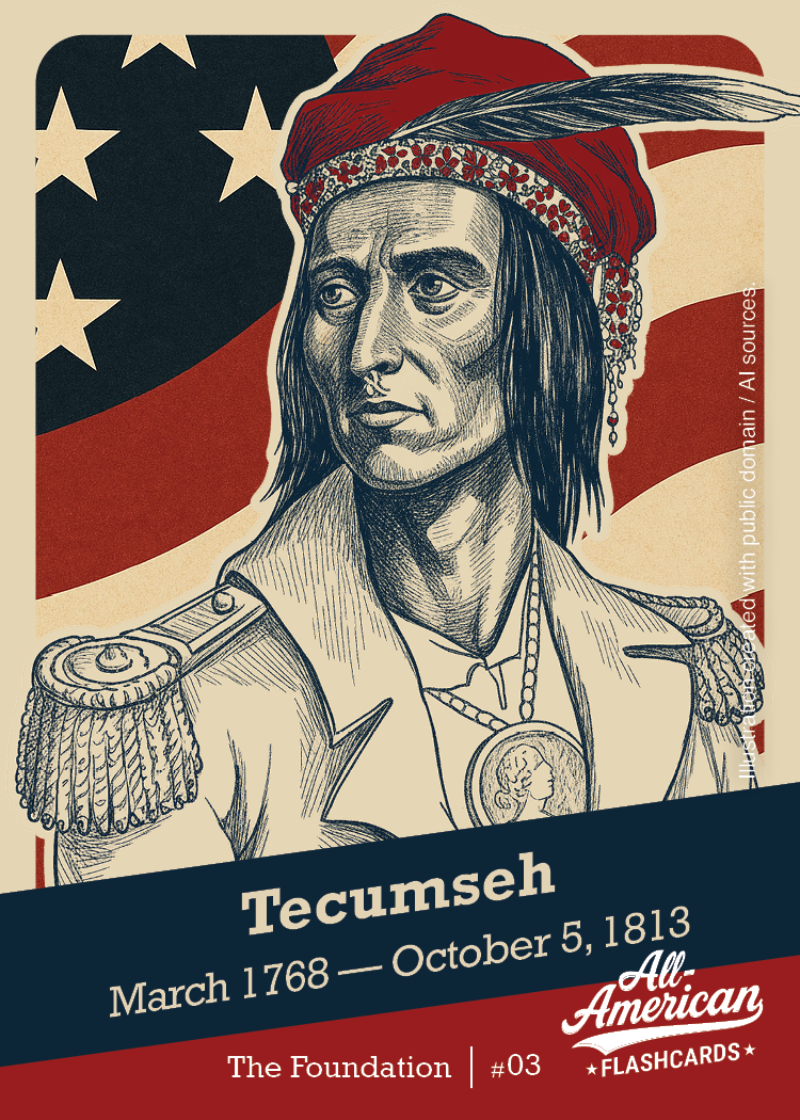
Tecumseh was a Shawnee leader, diplomat, and strategist who became one of the most powerful Indigenous opponents of U.S. expansion in the early nineteenth century. He lived in a world already transformed by war, settler pressure, treaty manipulation, and the violent expansion of the United States into Native homelands. Rather than treating these changes as isolated conflicts, Tecumseh understood them as part of a larger system of dispossession that threatened the future of Indigenous nations across the region. His response was both political and visionary. He argued that Native land could not rightfully be sold away by individual leaders acting separately, because the land was held collectively by Indigenous peoples and bound to their survival as distinct nations. This idea was radical in its challenge to U.S. policy, which often relied on making treaties with selected leaders and then treating those agreements as binding on much broader communities. Tecumseh believed only unity could counter that strategy. He traveled widely, seeking to build a confederacy among Native nations across the Great Lakes and Ohio Valley in order to resist U.S. encroachment more effectively. He is often remembered as a warrior, but that alone does not explain his historical importance. He was also a major political thinker whose ideas about sovereignty, collective rights, and territorial legitimacy struck at the core of how the United States justified expansion. His alliance with the British during the War of 1812 reflected not simple loyalty to empire, but a strategic effort to resist a more immediate colonial threat. Tecumseh’s death in 1813 did not end the pressures he fought against, and in some ways it marked the deepening of them. His story matters because it forces readers to see the early republic from the perspective of those who understood U.S. growth not as freedom expanding, but as land being taken. He stands as one of the clearest reminders that the making of the United States was also a history of Indigenous resistance, political thought, and survival under siege.
2
Why This Matters
Tecumseh matters because he forces readers to see the early United States from a different angle. In many school narratives, the young republic appears as a nation growing, organizing itself, and moving west. But from the perspective of Indigenous nations, that same process often meant broken treaties, military pressure, land theft, and the steady violation of sovereignty. Tecumseh belongs in the larger American story because he challenged the assumption that U.S. expansion was natural, legitimate, or uncontested. He named it for what it often was: dispossession.
His significance is not only military. Tecumseh was trying to solve a political problem that many Native nations faced as U.S. pressure increased. The United States often negotiated treaties with individual leaders or smaller groups and then treated those agreements as binding over much larger communities. Tecumseh rejected that model. He argued that land belonged collectively to Indigenous peoples and that no one group had the right to give it away unilaterally. That idea was powerful because it challenged the legal and moral framework through which the United States justified expansion. His story matters because it reminds readers that Indigenous resistance was not random or purely reactive. It was strategic, principled, and rooted in a sophisticated understanding of sovereignty.
3
What They Don’t Usually Tell You
What many people do not hear enough is that Tecumseh was more than a battlefield figure. He was a diplomat, organizer, and thinker who spent years traveling, speaking, and persuading. He understood that isolated resistance would likely fail against the expanding United States. That is why he tried to build a confederacy across tribal lines. This was difficult work. Native nations had distinct histories, interests, alliances, and pressures. Bringing them together required political imagination, not just courage.
Another under-taught truth is that Tecumseh’s world had already been shaped by generations of violence before he became famous. He grew up in the aftermath of warfare, settlement pressure, and colonial competition in the Ohio Valley. His resistance did not emerge in a vacuum. It developed in response to an expanding system that repeatedly ignored Native claims when they stood in the way of U.S. growth.
People also often hear Tecumseh only in connection with the War of 1812 or with his brother Tenskwatawa, sometimes called the Prophet. That connection matters, but Tecumseh should not be reduced to someone else’s movement or to one war. His importance lies in the larger political principle he defended: Indigenous nations had the right to land, self-determination, and collective decision-making. That principle did not die with him. It still echoes in Native legal fights, sovereignty claims, and land-rights movements today.
4
Timeline / Context
March 1768 – Tecumseh is born into the Shawnee world during a period of intense upheaval in the Ohio Valley.
Late eighteenth century – U.S. settlement pressure intensifies after independence. Violence, treaty-making, and land seizure reshape the region.
Early 1800s – Tecumseh emerges as a major leader arguing for Indigenous unity and resistance to U.S. territorial expansion.
1808 – Prophetstown is established in present-day Indiana as a center of Native political and spiritual organizing, connected especially with Tecumseh and Tenskwatawa.
1809 – The Treaty of Fort Wayne cedes large amounts of Indigenous land to the United States. Tecumseh strongly rejects it, arguing the land was held collectively and could not be sold by a small number of signers.
1810–1811 – Tecumseh travels widely to build support among multiple Native nations for coordinated resistance.
1811 – While Tecumseh is away recruiting allies, U.S. forces under William Henry Harrison attack Prophetstown in the Battle of Tippecanoe, damaging the movement.
1812–1813 – Tecumseh allies with the British during the War of 1812, seeing them as a counterweight to U.S. expansion.
October 5, 1813 – Tecumseh dies at the Battle of the Thames.
This context matters because Tecumseh’s life sits inside the collision between Indigenous sovereignty and American expansion. His story is not a side chapter. It is central to understanding what the growth of the United States actually cost.
5
Key Terms
Sovereignty – The authority of a people or nation to govern itself. Tecumseh defended Indigenous sovereignty against U.S. interference and land seizure.
Confederacy – An alliance of distinct groups working together for shared goals. Tecumseh tried to build a multi-nation Indigenous confederacy to resist dispossession.
Treaty of Fort Wayne – An 1809 agreement in which large amounts of Native land were ceded to the United States. Tecumseh rejected its legitimacy.
Prophetstown – A Native political and spiritual center in Indiana associated with Tecumseh and Tenskwatawa. It became a focal point of resistance.
War of 1812 – A war between the United States and Britain in which Native nations, including Tecumseh’s allies, played crucial roles shaped by their own goals and survival.
6
Related People
- Tenskwatawa
Tecumseh’s brother is essential to explore because the two were linked through a broader movement of Indigenous renewal and resistance. Studying them together helps explain how spiritual revival, political vision, and military strategy could overlap in Native struggles for survival. - William Henry Harrison
Harrison is a critical contrast because he represented the expansionist U.S. power that Tecumseh opposed. Pairing them helps readers understand that “westward growth” for the United States often meant direct confrontation with Native sovereignty. - Sacagawea
This is a meaningful connection because both stories sit in the early republic’s westward movement, but from very different angles. Sacagawea’s story reveals how Indigenous knowledge made expansion possible, while Tecumseh’s shows how Native leaders resisted the consequences of that expansion. - Harriet Tubman
Though they lived in different times and contexts, Tubman is a useful comparison if she is in the deck because both figures represent courage under pressure and leadership rooted in liberation. Reading them together can spark discussion about what resistance looks like in different systems of oppression.
7
Think About It
- Why do you think U.S. expansion is so often taught without equally emphasizing Indigenous resistance to it?
- What was powerful about Tecumseh’s idea that land belonged collectively, not just to whoever signed a treaty?
- How does Tecumseh’s story challenge common ideas about who the “founders” of the nation’s future really were?
8
Take It Further
- Search “Tecumseh Treaty of Fort Wayne sovereignty” to understand the legal and political principles behind his resistance.
- Explore Native perspectives on the War of 1812 rather than only U.S. and British accounts.
- Learn about Prophetstown and ask why Native centers of organizing are often treated as secondary in standard textbooks.
- Family discussion prompt: When powerful groups call expansion or growth “progress,” who gets to decide what that progress means?
9
Real-World Link
Tecumseh’s story connects directly to present-day struggles over Native sovereignty, land rights, legal recognition, and historical truth. Across the United States and beyond, Indigenous nations continue to fight for treaty rights, jurisdiction, environmental protection, and control over ancestral lands. Those are not separate from history. They are part of the long, unfinished story Tecumseh was living through. His vision also matters because it challenges the way many national stories are told. Too often, U.S. history celebrates expansion as energy, ambition, and destiny, while treating Native loss as an unfortunate side effect. Tecumseh forces a different question: expansion for whom, and at whose expense? That question still matters when communities debate pipelines, sacred sites, public land, mascots, curriculum, and the meaning of sovereignty today. Tecumseh remains important not only because he fought bravely, but because he named a principle that still matters: Indigenous nations are not obstacles in history. They are political communities with rights, memory, and claims that do not disappear just because a stronger power wants their land.


 Flashcards
 Games
Games Apparel & Homeware
 Travel
 Schools
 Memberships
 Sankofa Club (Children)
 About Us