

<< Go back to Main Page
Sojourner Truth
1
Quick Summary
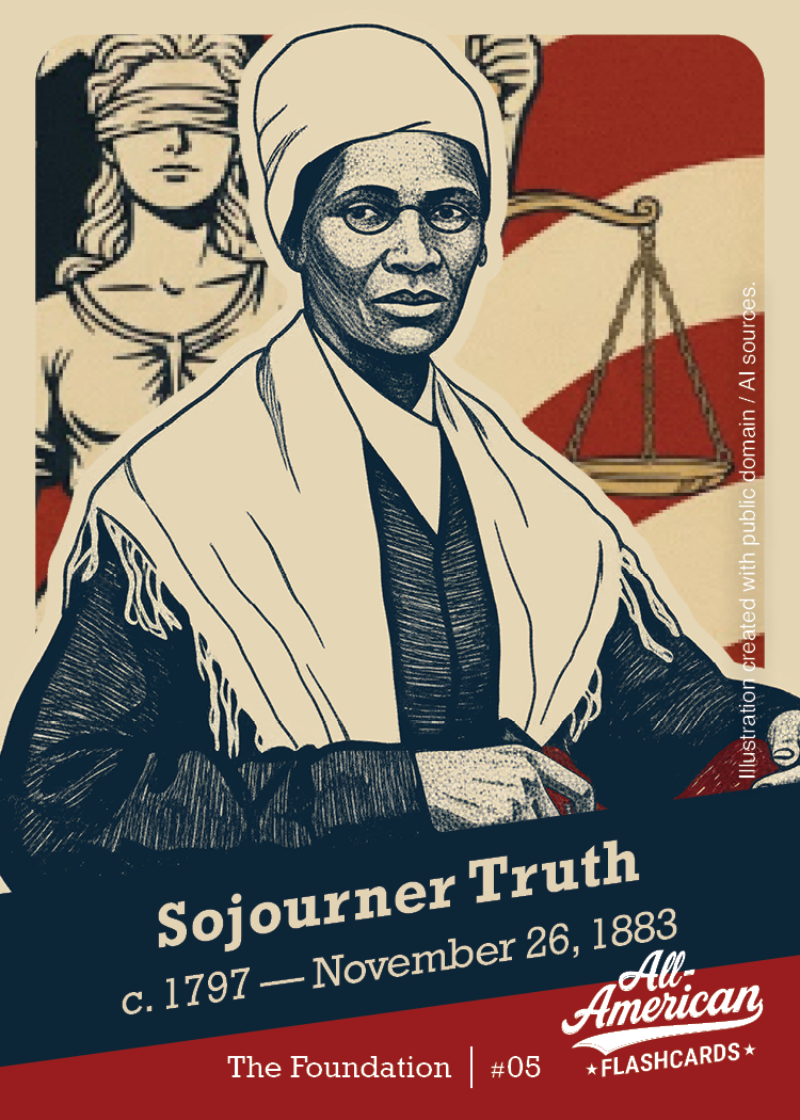
Sojourner Truth was an abolitionist, women’s rights advocate, and one of the most powerful public voices for freedom and human dignity in nineteenth-century America. Born into slavery in New York as Isabella Baumfree, she emerged from bondage with a moral force that would reshape reform movements across the country. After escaping slavery and later renaming herself Sojourner Truth, she turned her life into a mission of public witness, religious conviction, and unflinching truth-telling. She spoke not from distance or theory, but from direct experience of enslavement, labor exploitation, family separation, and the harsh racial and gender hierarchies of the United States. That experience gave her public voice unusual authority. Truth challenged slavery, but she also challenged the limits of reform movements that wanted to talk about women’s rights without fully confronting race, labor, and the place of Black women. She made clear that justice could not be divided neatly into separate categories without leaving the most vulnerable behind. Her speeches often unsettled audiences because they exposed contradictions many preferred to avoid. She forced Americans to ask whether a society could claim to believe in liberty while denying Black people humanity, and whether a women’s movement could speak honestly about womanhood while marginalizing Black women’s reality. Although later memory often reduces her to a few famous lines, her historical importance is much broader. She was part of a generation of Black freedom fighters who used speech, faith, and moral clarity to challenge the intellectual and spiritual foundations of oppression. She also remained active after the Civil War, advocating for the rights and welfare of freedpeople and continuing to insist that legal freedom without material justice would remain incomplete. Truth matters because she stands at the intersection of abolition, women’s rights, labor, race, and public morality. Her life reminds us that some of the strongest democratic voices in American history came from people the nation had tried hardest to silence.
2
Why This Matters
Sojourner Truth matters because she helps us see that justice movements are rarely as neat or unified as textbooks make them seem. The fight against slavery and the fight for women’s rights are often taught as separate stories with separate leaders, but Truth lived at the intersection of both. She forced reformers and audiences alike to confront uncomfortable questions. Could a nation claim to believe in liberty while millions remained enslaved? Could a women’s rights movement speak for all women if it ignored Black women’s labor, pain, and humanity? Could a Christian society call itself moral while defending systems built on violence and domination?
Her story belongs in the larger American story because she did not simply ask for inclusion. She challenged the very foundations of exclusion. She exposed how power worked through race, gender, and class at the same time. That matters now, but it mattered in her own era as well. Truth did not speak from the safety of abstraction. She spoke as someone who had survived the realities others preferred to debate from a distance.
She also matters because she represents a different kind of leadership. She did not hold elected office. She did not command armies or draft constitutions. Her power came through voice, conviction, and presence. She entered rooms that were not built for her and changed what people had to reckon with once she spoke. That is a form of nation-shaping power too. In fact, it is often one of the most overlooked forms. Sojourner Truth helped move American public life by refusing silence and refusing simplification.
3
What They Don’t Usually Tell You
What many people do not usually hear is that Sojourner Truth’s story began in a part of slavery that often gets less attention: slavery in the North. Because many Americans associate slavery almost entirely with the South, they can miss how deeply slavery shaped states like New York in earlier periods. Truth, born Isabella Baumfree, came out of that world. Her life reminds us that slavery was not just a Southern stain. It was embedded in the broader American system.
Another under-taught truth is that she did not become powerful because institutions welcomed her. She became powerful despite barriers of literacy, race, class, and gender. Truth did not fit the narrow image of respectable leadership that many reformers preferred. She was poor, formerly enslaved, deeply religious, and often judged through racist and sexist assumptions. Yet she became impossible to ignore. That matters because it shows how social movements can exclude even the very people most affected by injustice.
There is also a tendency to flatten Truth into a few famous lines, especially versions of the “Ain’t I a Woman?” speech. But that flattening can hide the complexity of both the speech and her broader life. Different versions of that speech circulated later, and not all of them reflect exactly how she spoke. The larger point is more important than any one phrase. Truth’s public message consistently challenged the idea that womanhood belonged only to white, delicate, protected women. She demanded that people see Black women as fully human and fully worthy of freedom, rights, and respect.
She also did more than speak. After the Civil War, she advocated for freedpeople, pushed for land and economic independence, and remained engaged in public struggles over equality. In other words, she was not only a witness to injustice. She was an organizer of conscience, pressing the country to move beyond symbolic sympathy toward real change.
4
Timeline / Context
1797 – Isabella Baumfree, later Sojourner Truth, is born into slavery in New York.
Early life – She endures enslavement, repeated sales, hard labor, and the trauma of family separation. Her early experiences shape the urgency and authority of her later public voice.
1826 – She escapes slavery with one of her children. Her freedom comes before the complete end of slavery in New York, placing her at the center of a changing legal and moral landscape.
1820s–1830s – She becomes involved in religious and reform circles. In 1843, she renames herself Sojourner Truth, signaling a life mission of traveling and speaking truth publicly.
1840s–1850s – She rises as a major abolitionist lecturer and begins speaking more forcefully on women’s rights as well.
1851 – She speaks at the Women’s Rights Convention in Akron, Ohio, in what becomes one of the most famous moments associated with her public life.
Civil War era – She supports the Union cause, speaks on behalf of Black freedom, and advocates for justice for formerly enslaved people.
Postwar years – She continues traveling, speaking, and pressing for rights, dignity, and material independence for Black Americans.
1883 – She dies, leaving behind one of the most powerful legacies in the history of American reform.
This context matters because Truth’s life stretched across slavery, emancipation, women’s rights activism, and the unfinished struggle for equality. She did not live in just one movement. She stood at the center of several.
5
Key Terms
Abolitionist – A person who worked to end slavery. Truth was one of the most powerful abolitionist speakers of her era.
Women’s rights – The effort to secure legal, social, and political equality for women. Truth challenged a version of this movement that often centered white women while overlooking Black women.
Emancipation – The act of being freed from slavery. For Truth, emancipation was not only personal freedom but part of a larger moral and political struggle.
Intersection of race and gender – The reality that systems of oppression do not affect everyone in the same way. Truth’s life shows how race and gender worked together in shaping inequality.
Public testimony – Speaking from direct lived experience to reveal truth and demand action. Truth used testimony as one of her greatest strengths.
6
Related People
- Frederick Douglass
Study Douglass with Truth to see how two formerly enslaved people became major voices against slavery through different styles of public leadership. Douglass often worked through writing and formal oratory, while Truth’s power came through direct testimony, moral confrontation, and the force of her presence. - Harriet Tubman
Tubman and Truth make a powerful pairing because both were formerly enslaved Black women who transformed survival into resistance. Studying them together helps learners compare different forms of courage: Tubman through covert liberation and wartime action, Truth through public speech and moral challenge. - Susan B. Anthony
Anthony is worth exploring alongside Truth because it helps reveal tensions inside the women’s rights movement. The comparison raises important questions about who was centered, who was excluded, and how race shaped struggles over citizenship and political rights. - John Brown
Brown connects because he represents another abolitionist willing to push the nation into moral crisis, though through very different methods. Pairing him with Truth helps readers think about the range of anti-slavery resistance, from prophetic speech to armed revolt.
7
Think About It
- Why is it important to study freedom through the experience of Black women, not only through male leaders or lawmakers?
- What does Sojourner Truth’s life reveal about the limits of reform movements that do not fully confront race and class?
- Why do you think some voices gain authority in public life more easily than others, even when the truth they speak is urgent?
8
Take It Further
- Search “Sojourner Truth slavery in New York” to explore the often-overlooked history of Northern slavery.
- Compare Sojourner Truth and Frederick Douglass to see how different abolitionist voices used different strategies to move public opinion.
- Explore the history of the women’s rights movement and ask who was centered and who had to fight to be heard within it.
- Family discussion prompt: What does it take for someone with little formal power to become one of the most powerful moral voices in a nation?
9
Real-World Link
Sojourner Truth’s story connects strongly to present-day conversations about intersectionality, representation, and who gets to define justice in public life. Many institutions now claim to care about equality, but her life pushes a harder question: equality for whom, and on whose terms? Truth reminds us that gender justice without racial justice is incomplete, and that moral language means little if it does not confront material inequality, exclusion, and power. Her story also matters in debates over education and public memory. When history is narrowed to a few heroic figures and simplified movements, people miss the voices that forced the nation to face its deepest contradictions. Truth remains relevant because she refused that simplification. She shows that democratic progress often depends on people who were never supposed to lead, but who tell the truth so clearly that the country can no longer hide from it. Her legacy is not only about the past. It is a standard for how to speak, resist, and insist on full humanity now.


 Flashcards
 Games
Games Apparel & Homeware
 Travel
 Schools
 Memberships
 Sankofa Club (Children)
 About Us