

<< Go back to Main Page
Sacagawea
1
Quick Summary
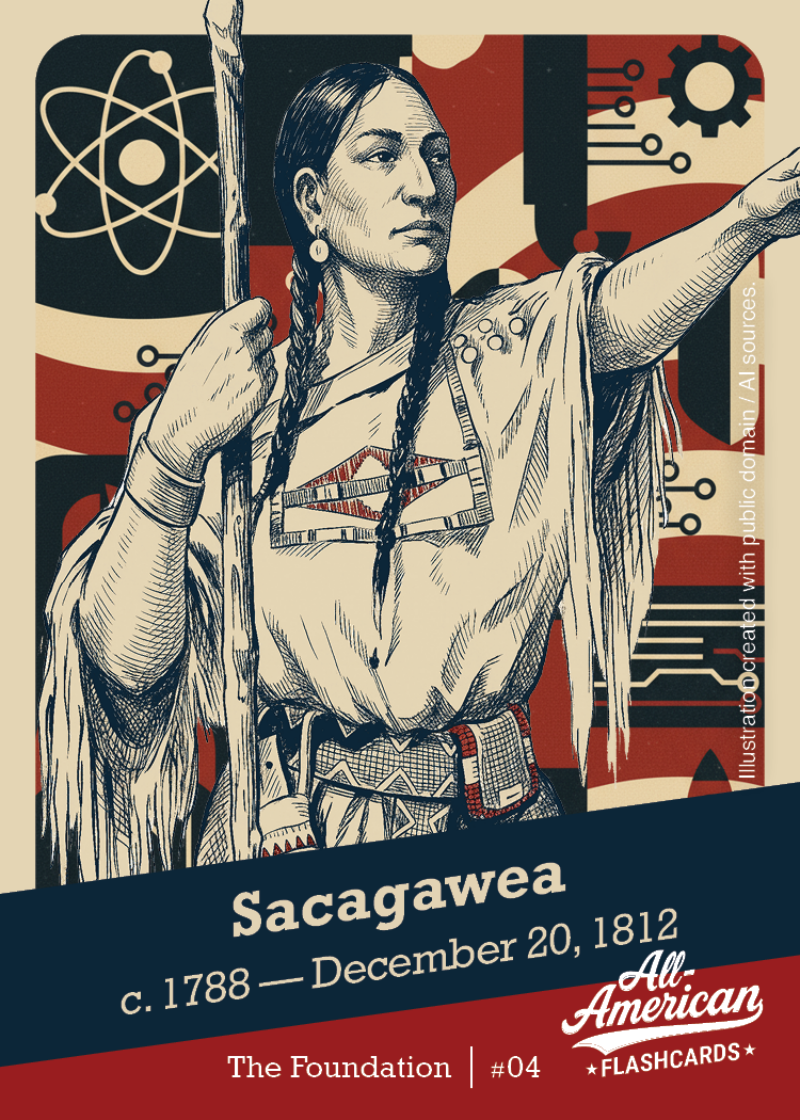
Sacagawea was a Shoshone woman whose role in the Lewis and Clark Expedition has made her one of the most widely recognized Indigenous figures in U.S. history, though the popular version of her story is often much simpler than the historical reality. She entered the expedition through a life already shaped by upheaval, displacement, and the complex political geography of Native nations in the West. By the time she traveled with Lewis and Clark, she had knowledge, language connections, and lived experience that proved valuable to a mission moving through lands that were not unknown wilderness, but Indigenous homelands with long-established systems of meaning, trade, and travel. Her contribution has often been summarized by calling her a guide or interpreter, but those labels do not fully capture the wider significance of her presence. She helped navigate cultural encounters, identify resources, support communication, and contribute to the survival of a group moving through unfamiliar and contested terrain. Her presence with her infant son also signaled something important in diplomatic terms, shaping how the traveling party could be perceived by others they encountered. At the same time, Sacagawea’s story cannot be separated from the larger project of U.S. expansion. The expedition she joined was part of an imperial process through which the United States sought knowledge, routes, influence, and future control across western lands. That means her story belongs not only to exploration, but also to the history of empire, Indigenous knowledge, and the unequal consequences of national growth. She has often been turned into a patriotic symbol, but the fuller history is more complex and more revealing. Sacagawea matters because she shows how much the United States depended on Native people even as it moved toward greater domination of Native lands. Her story invites readers to look past myth and ask who made exploration possible, whose knowledge was used, and who paid the deeper price for what later came to be celebrated as discovery.
2
Why This Matters
Sacagawea matters because her story forces us to look more carefully at how exploration actually worked. Too often, exploration is taught as if it were simply about brave national heroes moving into empty space. That version is false. The lands crossed by Lewis and Clark were not empty, unknown wilderness waiting to be discovered. They were homelands, trade zones, travel networks, and knowledge systems already inhabited and understood by Indigenous nations. Sacagawea belongs in the larger American story because she represents that reality. Her contribution was not decorative. She was part of the human knowledge that made the expedition possible.
Her story also matters because it opens a larger conversation about gender, power, and representation. Many public retellings turn Sacagawea into a symbol of loyalty to American expansion, but that framing can oversimplify what was really happening. She was a Shoshone woman living inside systems shaped by displacement, captivity, trade, and colonial ambition. Her role in the expedition deserves respect, but it should not be turned into a simple patriotic legend. A fuller understanding of her life helps readers see that American expansion relied not only on soldiers and officials, but also on Indigenous interpreters, women’s labor, and local knowledge that the nation later tried to overshadow.
3
What They Don’t Usually Tell You
One of the most important things people do not usually hear is that many details of Sacagawea’s life are uncertain, contested, or filtered through the writings of others. Much of what is known about her comes from expedition records created by men, not from her own written account. That means we have to be careful. Popular memory has often turned her into a fixed symbol, but the real historical record is more limited and uneven than many textbook summaries suggest.
Another under-taught truth is that the Lewis and Clark Expedition was not only a scientific or geographic journey. It was part of a larger U.S. imperial project after the Louisiana Purchase. The expedition gathered knowledge that would later support claims, settlement, military presence, and federal expansion. That matters because Sacagawea’s story is often celebrated without equally naming the consequences of the expansion she helped make possible. She did not create those consequences, and she should not be blamed for the entire arc of U.S. westward growth. But her story should be taught honestly within that larger context.
People also often assume that “guide” means she led the entire expedition across every mile. That is not the best way to understand her role. In some places, her greatest importance came through language, cultural signaling, resource knowledge, and relationships. Her presence with a baby could also signal that the traveling party was less likely to be a war party. In other words, her role was not only geographic. It was diplomatic, practical, and human.
4
Timeline / Context
1788 – Sacagawea is born into the Shoshone world of the northern Rocky Mountain region.
Childhood or early adolescence – She is reportedly captured by a Hidatsa-affiliated raiding party and later lives among Hidatsa communities, a reminder of the shifting and often difficult realities of the region.
Early 1800s – She is living near present-day North Dakota with Toussaint Charbonneau, a French Canadian trader, when the Lewis and Clark Expedition prepares to head west.
1804–1805 – Lewis and Clark recruit Charbonneau as an interpreter, and Sacagawea becomes part of the traveling group.
1805 – The expedition moves westward, and Sacagawea’s knowledge and language connections become especially important as the group nears Shoshone territory and seeks horses for crossing the Rockies.
1805–1806 – She helps identify plants, recover supplies after a boat incident, and navigate cross-cultural encounters.
1812 – One widely accepted account places her death in 1812, though later traditions and oral histories have sometimes told a different story.
This context matters because Sacagawea’s life intersected with an expedition that has long been celebrated as a national achievement. But from another angle, it was also a turning point in U.S. expansion into lands already known and inhabited by Indigenous peoples.
5
Key Terms
Shoshone – An Indigenous people with communities across the Intermountain West and surrounding regions. Sacagawea is commonly identified as Shoshone.
Lewis and Clark Expedition – A U.S. expedition sent after the Louisiana Purchase to gather information, map routes, establish relations, and extend American knowledge and influence westward.
Interpreter – A person who helps people speaking different languages understand one another. Sacagawea’s ability to support communication was a major part of her contribution.
Louisiana Purchase – The 1803 acquisition of a vast territory from France by the United States, which intensified U.S. exploration and expansion.
Indigenous knowledge – Knowledge developed through long experience, observation, cultural practice, and relationship to place. Sacagawea’s story is a powerful example of its importance.
6
Related People
- Meriwether Lewis and William Clark
These are obvious but important connections because Sacagawea’s historical visibility is tied closely to the expedition they led. Studying them together helps readers compare who gets centered in exploration stories and whose labor is often treated as support instead of leadership. - Tecumseh
Pairing Sacagawea with Tecumseh helps widen the picture of Indigenous history in the early republic. Her story shows Indigenous knowledge being used during expansion, while Tecumseh’s story shows organized resistance to the land hunger and sovereignty violations that expansion intensified. - Thomas Jefferson
Jefferson connects because he authorized the expedition as president. Reading him alongside Sacagawea reveals the gap between elite national planning and the Indigenous people whose lands, routes, and knowledge made that planning possible. - Zitkála-Šá
This is a valuable connection if she is in the deck because both women help readers think about Indigenous voice, representation, and the struggle over who gets to tell Native stories in American history.
7
Think About It
- How does Sacagawea’s story change the way you think about the word “exploration”?
- Why do you think Indigenous knowledge is so often used but not equally honored in national memory?
- What is lost when a complex historical figure is turned into a symbol without enough context?
8
Take It Further
- Search “Sacagawea historical record debate” to understand how historians handle incomplete or contested evidence.
- Explore the Lewis and Clark Expedition from both U.S. and Indigenous perspectives.
- Look into how the Louisiana Purchase affected Native nations over time.
- Family discussion prompt: Who usually gets credit in history, and who often does essential work without being treated as central?
9
Real-World Link
Sacagawea’s story connects strongly to present-day discussions about Indigenous visibility, public memory, and the ethics of how history is taught. She is often honored in symbolic ways, but symbols can hide as much as they reveal. Her life invites readers to ask whether the nation remembers Indigenous people mainly when they can be folded into uplifting stories of American achievement, while overlooking Native sovereignty, survival, and resistance. Her story also matters because it reminds us that knowledge is power, and that the United States has long depended on Indigenous knowledge even while undermining Indigenous nations. In education today, that raises a major question: are students being taught a deeper history of land, language, and Native contribution, or only simplified stories that make expansion feel inevitable and harmless? Sacagawea deserves more than myth. She deserves to be understood as a real person whose life stands at the crossroads of gender, empire, survival, and memory.


 Flashcards
 Games
Games Apparel & Homeware
 Travel
 Schools
 Memberships
 Sankofa Club (Children)
 About Us