

<< Go back to Main Page
Bernardo de Gálvez
1
Quick Summary
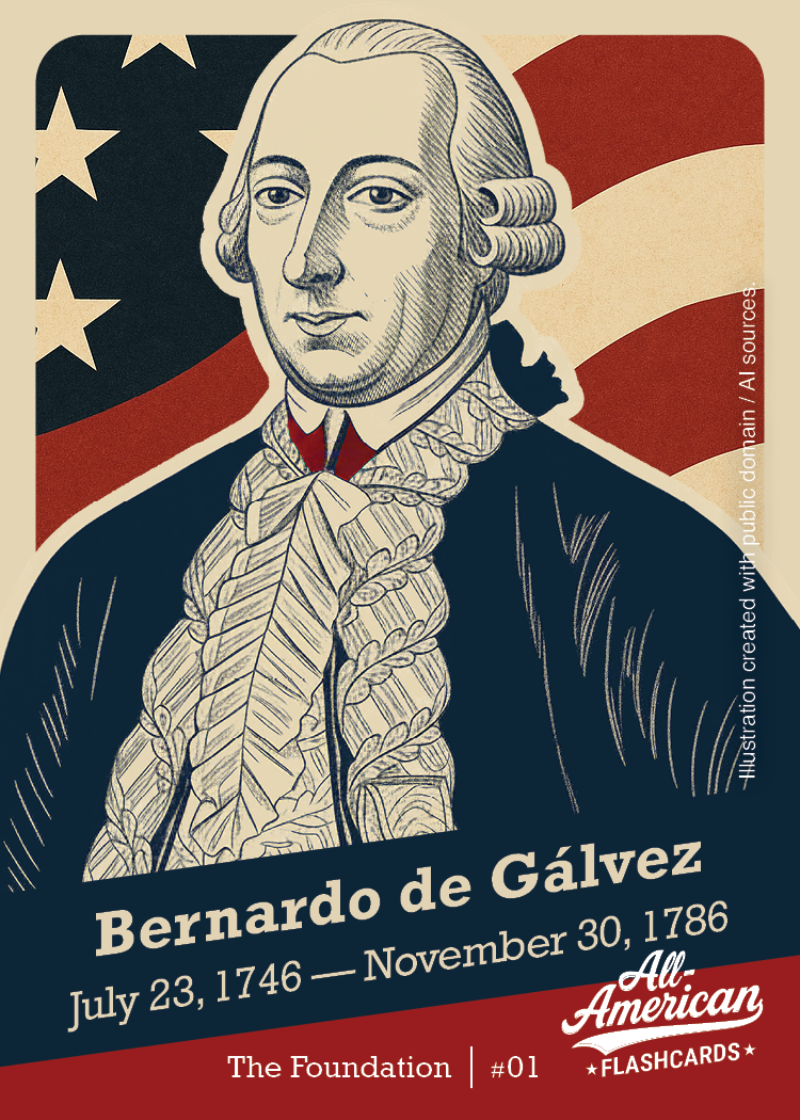
Bernardo de Gálvez was a Spanish military leader and colonial governor of Louisiana during the American Revolution. While Britain was fighting the American colonies, Gálvez helped weaken British power along the Gulf Coast and the Mississippi River. He moved supplies to the American cause, launched military campaigns against British positions, and captured key forts, including Pensacola in 1781. His actions disrupted British strategy and helped the United States move closer to victory.
2
Why This Matters
Most people are taught that the American Revolution was mainly a fight between the colonies and Britain, with France as the best-known ally. But Spain also played an important role. Bernardo de Gálvez weakened British control in the South, protected key trade and supply routes, and forced Britain to fight on more fronts. His story matters because it shows that the fight for American independence was not won alone , it was shaped by international power, strategy, and overlooked allies.
3
What They Don’t Usually Tell You
What many people do not learn is that the American Revolution was also a global war. Spain did not just stand by and watch. Under Gálvez’s leadership, Spanish Louisiana became a major channel for supplies moving to the American side through New Orleans and the Mississippi River. His victories at Baton Rouge, Mobile, and Pensacola were not side stories — they helped break British strength along the Gulf Coast. His role was so important that later generations recognized him as one of the foreign figures who contributed directly to U.S. independence, even though his name is still far less well-known than that of other Revolutionary leaders.
4
Timeline / Context
1746 – Bernardo de Gálvez is born in Spain.
1776 – The American colonies declare independence from Britain.
1777 – Gálvez becomes governor of Spanish Louisiana.
1777–1779 – Supplies move through New Orleans and the Mississippi corridor to aid the American cause.
1779 – Spain enters the war openly against Britain.
1779 – Gálvez captures British positions at Baton Rouge and Natchez.
1780 – He captures Mobile.
1781 – He captures Pensacola, one of Britain’s most important strongholds in West Florida.
1783 – The Treaty of Paris officially ends the Revolutionary War.
5
Key Terms
Spanish Louisiana – A large North American territory controlled by Spain, including New Orleans and the lower Mississippi region.
Mississippi–Gulf corridor – A major route linking inland river movement to Gulf Coast access, important for transport, trade, and war strategy.
Supply lines – The routes used to move weapons, food, medicine, and equipment to armies.
Pensacola – A major British military stronghold in West Florida during the Revolutionary War.
American Revolution – The war in which the thirteen colonies fought for independence from Britain.
6
Related People
- George Washington
Explore how Washington led the Continental Army on the main colonial front while Gálvez helped weaken Britain from the Gulf Coast. - Marquis de Lafayette
Compare how foreign allies like Lafayette and Gálvez supported the American cause in different ways — one through French military partnership, the other through Spanish strategy and Gulf Coast victories. - Benjamin Franklin
See how Franklin helped secure international support through diplomacy, while Gálvez helped turn foreign support into action on the ground. - Treaty of Paris (1783)
Connect Gálvez’s military victories to the larger outcome of the war and the formal recognition of American independence. - Crispus Attucks
Pair this card with Attucks to see how the Revolutionary era included both overlooked international allies and often-under-taught Black patriots.
7
Think About It
- Why do you think some allies in U.S. history are remembered more than others?
- How might the outcome of the American Revolution have changed if Britain had stayed stronger along the Gulf Coast?
- What does Bernardo de Gálvez’s story teach us about how history is often simplified?
8
Take It Further
Family discussion prompt:
Ask: What are some important people in history whose names are not widely known, even though their actions changed the outcome of major events? Why do some stories get centered while others get pushed aside?
Topic to search:
“Spain’s role in the American Revolution”
or
“Bernardo de Gálvez Pensacola 1781”
9
Real-World Link
Bernardo de Gálvez’s story connects to Americans’ understanding of national identity. It reminds us that U.S. history was never built in isolation. Foreign alliances, trade routes, military strategy, and multicultural power all shaped the nation’s founding. Today, his story also connects to broader conversations about whose contributions are remembered in textbooks, public monuments, and national memory, and whose contributions are minimized.


 Flashcards
 Games
Games Apparel & Homeware
 Travel
 Schools
 Memberships
 Sankofa Club (Children)
 About Us