

<< Go back to Main Page
Clara Barton
1
Quick Summary
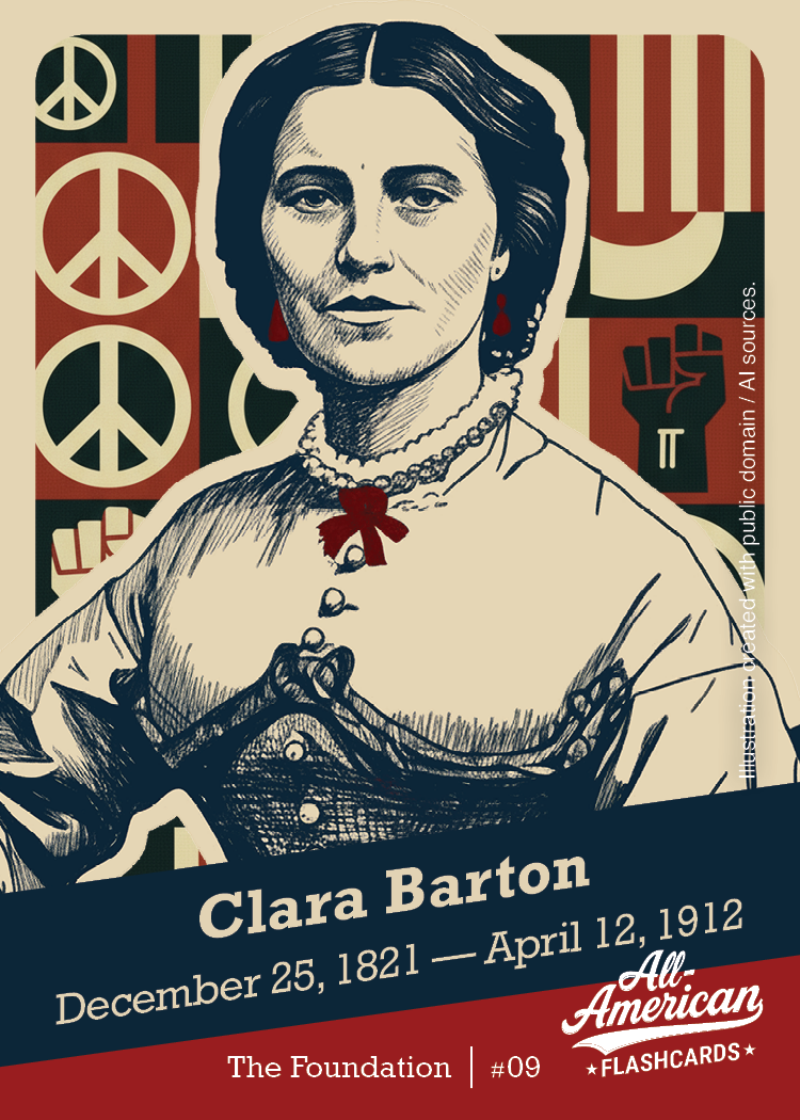
Clara Barton was a nurse, organizer, humanitarian, and institution-builder whose work changed how Americans understood care, crisis, and public responsibility. Born in 1821 in Massachusetts, Barton first built a life in education and government service before becoming nationally known during the Civil War, when she moved directly into zones of danger to bring supplies and aid to wounded soldiers. She earned fame as the “Angel of the Battlefield,” but that phrase, though memorable, can make her seem softer and less strategic than she really was. Barton was not important simply because she cared for the suffering. She mattered because she organized, transported, documented, and responded where official systems were failing. Her work revealed that war tests not only armies and governments, but a society’s willingness to care for the wounded, account for the dead, and respond to human need with seriousness and structure. After the war, Barton remained committed to relief work and became a driving force behind the founding of the American Red Cross. In doing so, she helped create a more durable national approach to humanitarian aid, one that extended beyond wartime and into peacetime disaster response. This was a major shift in public life. Barton showed that care could be institutional as well as personal, and that emergency response could be a civic obligation rather than an act of occasional charity. Her story also matters because she expanded women’s public leadership in a period when women were often expected to serve quietly without openly leading. She moved into spaces of danger, administration, and national influence that many would have considered inappropriate for women of her time. Barton’s life belongs in the American story because it broadens the meaning of leadership itself. She reminds us that the making of a nation depends not only on those who fight wars or make laws, but also on those who build systems capable of responding to suffering with dignity and urgency.
2
Why This Matters
Clara Barton matters because she helps readers understand that nations are shaped not only by generals, presidents, and battlefield victories, but also by the people who confront suffering directly and build systems to respond to it. War does not only test military strength. It tests whether a society can care for the wounded, bury the dead, support families, and restore some measure of humanity amid chaos. Barton stepped into that space with unusual courage and determination.
She belongs in the larger American story because her life sits at the intersection of gender, service, and institution-building. In the nineteenth century, women were often expected to serve quietly and privately, not lead publicly in moments of national crisis. Barton moved beyond those limits. She entered places of danger, took on responsibilities many thought inappropriate for women, and insisted on acting where the need was greatest. Later, by helping establish the American Red Cross, she expanded the meaning of relief work in the United States. She helped create a framework for responding not only to war, but also to floods, epidemics, fires, and other disasters.
Her story also matters because it complicates what counts as leadership. Too often, leadership is imagined mainly as command, conquest, or public office. Barton shows another model. Leadership can also mean identifying need quickly, organizing under pressure, and refusing to let suffering remain invisible. Her life asks readers to take humanitarian labor seriously as part of nation-building.
3
What They Don’t Usually Tell You
What many people do not usually hear is that Barton’s work was as much organizational as it was emotional. Public memory often turns her into a symbol of kindness, but kindness alone does not move wagons of supplies, manage relief networks, or build a durable institution. Barton was effective because she combined compassion with administration, persistence, and a willingness to act where formal systems were failing.
Another under-taught point is that her rise came in a society that did not easily welcome women into authority. She faced skepticism, resistance, and structural limitations. Even before the Civil War, she had worked as a teacher and as one of the first women employed in a significant role at the U.S. Patent Office. That matters because Barton’s later public achievements did not emerge from nowhere. They grew from a longer pattern of stepping into roles that were often restricted or underappreciated for women.
People also often focus heavily on her Civil War service and less on the broader significance of the American Red Cross. Barton helped adapt an international humanitarian model to U.S. circumstances and argued that disaster relief in peacetime belonged within that mission. That was important. It widened the idea of public emergency response and made organized relief part of civic responsibility.
At the same time, Barton’s legacy, like many major historical figures, is not free from complication. Building institutions involves conflict, management challenges, and criticism. Remembering her only as a saintly figure can flatten the story. It is more useful to understand her as a determined, imperfect, highly capable organizer whose work changed the way Americans thought about service and emergency care.
4
Timeline / Context
1821 – Clara Barton is born in Massachusetts.
Early adulthood – She works as a teacher and later becomes involved in public service, including work at the U.S. Patent Office, where she breaks barriers for women in government employment.
1861–1865 – During the Civil War, Barton begins collecting and distributing supplies and later goes to the front lines to care for wounded soldiers and deliver aid under dangerous conditions.
Postwar period – She helps identify missing soldiers and continues relief-related work, showing that care after conflict is as important as care during battle.
1869–1873 – Barton travels in Europe, where she learns more about the International Red Cross and humanitarian frameworks already developing abroad.
1881 – She founds the American Red Cross.
1880s–1890s – Under Barton’s leadership, the organization responds to disasters such as floods, epidemics, and other emergencies, expanding relief work in the United States beyond wartime concerns.
1912 – Barton dies, having helped create one of the country’s most enduring humanitarian institutions.
This timeline matters because it shows Barton’s impact was not limited to one war. She helped reshape the infrastructure of care itself.
5
Key Terms
Humanitarian – A person devoted to improving human welfare and reducing suffering. Barton’s life is a major example of humanitarian leadership.
Relief work – Organized aid given to people affected by war, disaster, or crisis. Barton helped make this a more formal part of American public life.
American Red Cross – The U.S. relief organization Barton founded in 1881, modeled in part on international Red Cross principles but adapted to American needs.
Battlefield nursing – Care provided to wounded soldiers in or near zones of military conflict. Barton became famous for doing this under dangerous conditions.
Disaster response – Organized efforts to help communities recover from emergencies such as floods, fires, and epidemics. Barton helped expand this concept in the U.S.
6
Related People
- Harriet Tubman
Tubman is a meaningful connection because both women stepped into wartime service in ways that challenged narrow expectations of women’s roles. Studying them together helps readers compare humanitarian care, intelligence work, and practical courage under extreme conditions. - Dorothea Dix
If Dix is in the deck, she is a strong pairing because both women were associated with care during the Civil War, but with different responsibilities and institutional roles. Comparing them helps readers understand the broader landscape of wartime nursing and reform. - Florence Nightingale
Nightingale is useful even as an international comparison because she helps place Barton in a wider history of modern nursing, public health reform, and organized care. Studying them together shows how women in different contexts transformed the meaning of medical and relief work. - American Red Cross / Red Cross Movement
This is worth exploring because Barton’s legacy is inseparable from the institution she built. The connection helps readers see how one person’s service can become a lasting national framework for emergency response.
7
Think About It
- Why is care work so often praised symbolically but undervalued when people talk about leadership and history?
- What does Clara Barton’s life show about the relationship between compassion and organization?
- Why might a nation need institutions of relief just as much as it needs institutions of war or government?
8
Take It Further
- Search “Clara Barton American Red Cross founding” to learn how her wartime experience shaped a national relief institution.
- Compare Clara Barton and Harriet Tubman during the Civil War to see different forms of service and courage.
- Explore the history of disaster relief in the United States and ask how emergency care became part of civic responsibility.
- Family discussion prompt: Who do we usually call heroes in history, and what happens when we take caregiving and relief work just as seriously as military or political leadership?
9
Real-World Link
Clara Barton’s story connects directly to modern debates about emergency response, public health, caregiving, and who carries society through crisis. In times of disaster, people often praise first responders, nurses, aid workers, and volunteers, but those same forms of labor are frequently underfunded, undervalued, or treated as secondary when the crisis fades. Barton’s life reminds us that relief work is not an extra. It is part of the basic infrastructure of a functioning society. Her story also matters in conversations about women’s leadership. She challenged the idea that women belonged only in the private sphere by showing that care could be organized publicly, strategically, and at national scale. Today, whether the issue is disaster relief, medical systems, mutual aid, or emergency preparedness, Barton’s legacy still speaks. She shows that a country is not judged only by how it wages war or celebrates victory, but by how it responds to injury, vulnerability, and need.


 Flashcards
 Games
Games Apparel & Homeware
 Travel
 Schools
 Memberships
 Sankofa Club (Children)
 About Us