

<< Go back to Main Page
Frederick Douglass
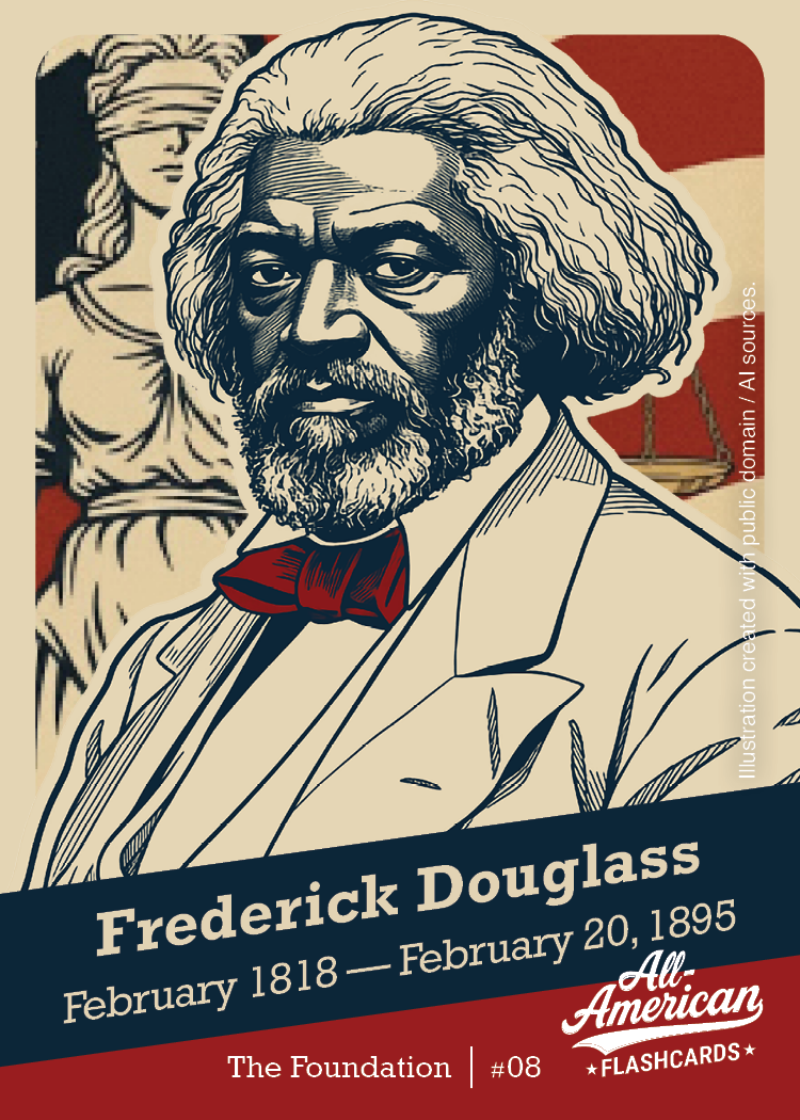
1
Quick Summary
Frederick Douglass was one of the greatest abolitionists, writers, and democratic thinkers in American history, a man who transformed his own escape from slavery into a lifelong struggle to redefine freedom for the nation itself. Born into slavery in Maryland in 1818, Douglass came to understand early that literacy, self-possession, and political awareness were deeply threatening to a system built on human bondage. After escaping slavery in 1838, he did not simply seek a private life of safety. He became one of the most powerful public voices against slavery, using speeches, autobiographies, newspapers, and political argument to expose the cruelty and hypocrisy of a country that praised liberty while holding millions in chains. Douglass’s brilliance lay not only in his moral condemnation of slavery, but in his ability to interpret what slavery revealed about American democracy. He understood that bondage distorted not only the lives of the enslaved, but the meaning of citizenship, law, and national identity itself. His autobiographies gave him unusual authority because he claimed the right to narrate his own life in a society determined to deny Black people full humanity. Over time, Douglass also broadened his focus beyond abolition alone. During and after the Civil War, he pushed for Black enlistment, voting rights, equal protection, and the full political meaning of emancipation. He refused to accept that freedom could be considered complete if formerly enslaved people remained exposed to violence, exclusion, and inequality. Douglass also evolved intellectually, moving through debates over the Constitution, party politics, and the relationship between moral suasion and institutional power. That complexity makes him more important, not less. His life matters because he forced the United States to confront whether it truly intended freedom to belong to everyone. He remains essential not only as a former slave who became a great man, but as one of the nation’s sharpest interpreters of liberty, democracy, and the lies nations tell about themselves.
2
Why This Matters
Frederick Douglass matters because he helps readers understand that the struggle against slavery was also a struggle over truth, humanity, and belonging. Slavery depended not only on physical violence, but on a system of ideas that treated Black people as property, denied their intellect, and tried to erase their political personhood. Douglass shattered those lies publicly. Every speech he gave, every page he wrote, and every argument he made challenged the foundations of white supremacy in both law and culture.
He belongs in the larger American story because he lived through and shaped several of the country’s most important transformations: slavery, abolition, the Civil War, emancipation, Reconstruction, and the postwar fight over citizenship. He was not a passive observer of those events. He was one of their great participants and interpreters. Douglass pressed Americans to ask whether freedom would be real or merely symbolic. Would emancipation be followed by voting rights, education, legal protection, and economic opportunity? Or would the nation free enslaved people only to leave them vulnerable to new forms of domination?
His importance also lies in the way he used language as a weapon against injustice. Douglass knew that stories shape power. That is why his autobiographies mattered so much. He did not allow others to define him. He claimed authorship over his own life and turned personal testimony into national indictment. That matters today because Douglass reminds us that public narratives are never neutral. They shape who is seen as fully human, fully American, and fully deserving of rights.
3
What They Don’t Usually Tell You
What many people do not usually hear is that Douglass’s life was not only a triumph of individual brilliance. It was also shaped by networks, conflict, reinvention, and constant danger. He is often celebrated as a self-made man, and in some ways that is true. He taught himself to read more deeply, escaped slavery, and built a public life through extraordinary determination. But that framing can oversimplify the larger reality. Douglass rose within abolitionist circles, benefited from allies, and also struggled with those same circles when white reformers tried to control his image or limit his independence.
Another under-taught point is that Douglass changed over time. Early in his public career, he was closely associated with William Lloyd Garrison and a moral-suasion approach to abolition. Later, he moved toward a broader political strategy and took a different view of the Constitution, arguing that it could be used as an anti-slavery document rather than rejected as hopelessly pro-slavery. That evolution matters because it shows Douglass was not simply repeating slogans. He was thinking, revising, and responding to changing realities.
People also sometimes remember Douglass mainly for his famous 1852 speech asking what the Fourth of July meant to the enslaved. That speech is essential, but it is only one part of his legacy. Douglass also pushed hard during the Civil War for Black enlistment, recognizing that military service could become a claim to citizenship. After the war, he fought for voting rights and civil equality, warning that formal emancipation without real protection would leave freedom exposed. In other words, Douglass was not only an anti-slavery speaker. He was a long-term strategist of Black freedom.
4
Timeline / Context
1818 – Frederick Douglass is born into slavery in Maryland. He is born Frederick Bailey and experiences the violence, uncertainty, and family separation that marked plantation slavery.
Childhood and adolescence – He is exposed to literacy in small but life-changing ways. Learning to read becomes one of the turning points of his life, helping him understand both the structure of slavery and the possibility of resistance.
1838 – Douglass escapes slavery and travels north. He eventually settles in Massachusetts and begins a new life as a free man, though still under threat from slave-catching laws.
1840s – He emerges as a compelling abolitionist speaker. His firsthand testimony of slavery draws national attention.
1845 – He publishes Narrative of the Life of Frederick Douglass, an enslaved American, one of the most influential autobiographies in American history.
1840s–1850s – Because publication increases the risk of recapture, he spends time abroad, including in Britain, before returning to the United States.
1847 onward – He begins publishing his own newspaper, giving himself a platform independent of white abolitionist control.
1852 – He delivers his famous speech, “What to the Slave Is the Fourth of July?” exposing the hypocrisy of American freedom claims under slavery.
Civil War era – Douglass pushes for Black enlistment in the Union cause and argues that military service must be tied to citizenship and equality.
Reconstruction and after – He continues fighting for Black civil rights, voting rights, and equal protection under law.
1895 – Douglass dies after a lifetime of activism, writing, and public service.
This timeline matters because Douglass’s life did not stop at escape. He kept redefining what freedom had to mean in practice.
5
Key Terms
Abolition – The movement to end slavery. Douglass became one of its most influential leaders and voices.
Autobiography – A person’s account of their own life. Douglass used autobiography as a political tool to expose slavery and claim authority over his own story.
Emancipation – Freedom from slavery. For Douglass, emancipation had to lead to full citizenship, not just legal release from bondage.
Citizenship – Full membership in a political community, including rights, protections, and participation. Douglass fought to make Black citizenship real.
Reconstruction – The period after the Civil War when the United States struggled over how to rebuild and whether formerly enslaved people would receive real rights and power.
6
Related People
- Sojourner Truth
Pair Douglass with Truth to explore how two formerly enslaved people used public speech to confront slavery and inequality, but from different positions and styles. Studying them together helps readers think about gender, voice, and the different burdens placed on Black male and Black female leadership. - Harriet Tubman
Tubman and Douglass make a powerful pairing because both turned self-liberation into a broader struggle for others. Douglass fought slavery through writing, organizing, and political argument, while Tubman risked her life repeatedly through direct rescue and wartime action. - John Brown
Brown is an essential connection because Douglass knew him and respected his hatred of slavery, even while doubting the plan at Harpers Ferry. Studying them together opens important questions about strategy, violence, and the range of abolitionist resistance. - Abraham Lincoln
Lincoln connects because his relationship to emancipation and Black rights is often taught in simplified ways. Reading Douglass with Lincoln helps show how Black activists pressured federal power and why emancipation was not only something granted from above.
7
Think About It
- Why was literacy so threatening to the system of slavery, and why did it matter so much in Douglass’s life?
- What does Douglass’s life reveal about the difference between legal freedom and full equality?
- Why is it important to study how formerly enslaved people shaped the meaning of American democracy, not just how lawmakers or presidents described it?
8
Take It Further
- Search “Frederick Douglass Narrative significance” to understand why his autobiography became such a powerful anti-slavery text.
- Compare Douglass’s speeches before and after the Civil War to see how his focus expanded from abolition to citizenship and civil rights.
- Explore Douglass’s relationship with John Brown and ask what it reveals about tensions within the anti-slavery movement.
- Family discussion prompt: What does it mean for someone to not only gain freedom, but to redefine what freedom should mean for a whole country?
9
Real-World Link
Frederick Douglass’s story remains urgent because many of the questions he raised are still unresolved. What is the difference between formal equality and lived equality? How do nations celebrate freedom while tolerating systems that leave some groups underprotected, misrepresented, or denied real power? Douglass also matters because he understood that representation is never enough by itself. Symbolic inclusion without rights, safety, education, opportunity, and political influence is not justice. His life speaks directly to modern debates about citizenship, voting rights, education, racial inequality, media narratives, and public memory. He reminds us that democracy is not self-correcting. It must be pushed, challenged, and made more honest by people willing to name its contradictions. Douglass remains one of the clearest examples of how a person denied full humanity by the law can become one of the nation’s greatest interpreters of liberty. That is not just inspiring. It is instructive. It shows that those pushed to the margins often understand the center more clearly than those protected by it.


 Flashcards
 Games
Games Apparel & Homeware
 Travel
 Schools
 Memberships
 Sankofa Club (Children)
 About Us