

<< Go back to Main Page
Henry David Thoreau
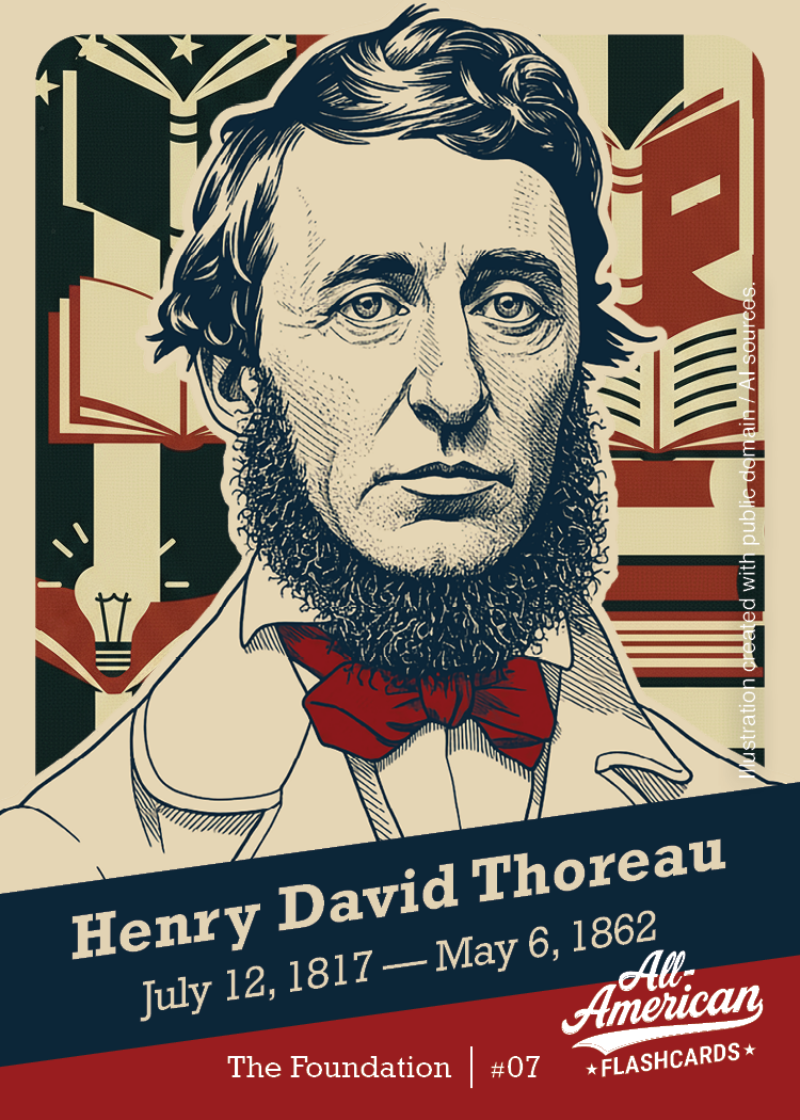
1
Quick Summary
Henry David Thoreau was a writer, philosopher, and political thinker whose ideas about conscience, government, and moral resistance would shape movements far beyond his own lifetime. Born in 1817 in Massachusetts, he is often remembered for his reflections on nature and simple living, especially through Walden, but that image alone does not capture the full force of his historical importance. Thoreau lived in a United States deeply marked by slavery, expansion, and war, and he believed that individuals could not claim innocence while cooperating with unjust systems. His refusal to pay a poll tax in protest of slavery and the Mexican-American War became the basis for the essay later known as Civil Disobedience, one of the most influential political texts in modern history. In that essay and in his public life, Thoreau argued that obedience to law is not the highest civic virtue when the law itself protects injustice. He insisted that conscience must take precedence over passive loyalty to the state. This was a radical claim in a democracy that often preferred order to moral accountability. Thoreau’s politics were sharper than the softened version of him often taught in schools. He opposed slavery fiercely, criticized American expansionism, and later defended John Brown when many more moderate Americans recoiled from him. His work mattered because it gave intellectual shape to the idea that resistance to unjust government is not disorder, but responsibility. Later figures such as Mahatma Gandhi and Martin Luther King Jr. would draw from his thinking, adapting it to mass movements for justice. Thoreau’s life belongs in the American story because he asked one of democracy’s most enduring questions: what should a person do when the state demands compliance with wrongdoing? His answer continues to challenge any society that treats legality as the same thing as justice.
2
Why This Matters
Thoreau matters because he asked a question that still unsettles democratic societies: what should a person do when the law protects injustice? Many people are taught to think of good citizenship as obedience, patience, and trust in institutions. Thoreau challenged that idea directly. He argued that when government supports wrongdoing, simple compliance is not neutral. It becomes participation. That was a radical claim in his time, and it remains powerful now.
He belongs in the larger American story because he helped define an ethic of resistance that later movements would adapt in major ways. He did not invent protest, and he was not the only critic of injustice in his era, but he gave language to a problem that democratic nations often try to avoid. If a government has popular legitimacy, does that automatically make its laws just? Thoreau answered no. He insisted that conscience must not disappear inside majority rule.
His importance also lies in the fact that he connected ideas to action. Thoreau did not merely write that slavery was wrong or that war was unjust. He acted on his convictions, however modestly in immediate scale, by refusing cooperation. That made his political philosophy practical. He was saying that ordinary people are not powerless while waiting for the perfect reformer, election, or court ruling. They already make choices every day about what they will support, fund, excuse, or resist.
3
What They Don’t Usually Tell You
What many people do not usually hear is that Thoreau’s politics were sharper and more urgent than the softened version often presented in schools. He is sometimes remembered mainly as the quiet man at Walden Pond, absorbed in nature and simplicity. That image is real but incomplete. Thoreau was also deeply engaged in the moral crises of his time. He opposed slavery fiercely, condemned the Mexican-American War, and later defended militant abolitionist John Brown when many moderates recoiled.
Another under-taught point is that civil disobedience was not, for Thoreau, simply about polite disagreement. It was about refusing to lend one’s body, labor, money, or legitimacy to injustice. He did not believe moral responsibility ended at private opinion. If the state was doing wrong, he thought citizens had to withdraw cooperation.
It is also important not to overstate his exact method as if it were identical to later nonviolent movements. Gandhi and Martin Luther King Jr. would later draw from Thoreau, but they developed mass strategies shaped by different histories and goals. Thoreau’s contribution was foundational, but not identical to everything later built on it. What makes him important is that he gave one powerful early American answer to the problem of unjust law: resist it, even if resistance brings punishment.
His life also reflects a tension worth noting. He was able to make some of these choices from a position shaped by race, gender, and relative social standing that differed sharply from the positions of enslaved people or poor laborers. That does not erase his courage, but it should remind readers that conscience-based protest always operates within unequal conditions. Some people pay far more for dissent than others.
4
Timeline / Context
1817 – Henry David Thoreau is born in Concord, Massachusetts.
1830s–1840s – He becomes associated with the transcendentalists, including Ralph Waldo Emerson, and develops a philosophy emphasizing conscience, self-examination, and resistance to conformity.
1846 – Thoreau refuses to pay a poll tax, objecting in part to slavery and the Mexican-American War. He is briefly jailed.
1849 – His essay on resistance to unjust government is published, later becoming widely known as Civil Disobedience.
1850s – The crisis over slavery deepens nationally. Thoreau becomes more outspoken in abolitionist politics.
1854 – Walden is published, contributing to his literary fame.
1859 – After John Brown’s raid on Harpers Ferry, Thoreau publicly defends Brown when many others condemn him.
1862 – Thoreau dies at age 44.
This context matters because Thoreau was writing in an era when slavery, war, expansion, and law were colliding in ways that exposed the limits of comfortable citizenship. His ideas grew out of crisis, not abstraction alone.
5
Key Terms
Civil disobedience – The refusal to obey laws or cooperate with government actions considered unjust. Thoreau helped define the concept for modern political thought.
Conscience – A person’s inner moral sense of right and wrong. For Thoreau, conscience could outrank law.
Transcendentalism – A nineteenth-century intellectual movement that emphasized individual conscience, self-reliance, and spiritual insight beyond convention.
Poll tax – A tax levied on individuals. Thoreau’s refusal to pay it became a symbolic act of protest.
Mexican-American War – A war between the United States and Mexico that many critics, including Thoreau, saw as tied to expansion and the spread of slavery.
6
Related People
- John Brown
Brown is one of the most important people to pair with Thoreau because Thoreau defended him publicly when many respectable Americans would not. Studying them together helps readers see that conscience can lead people not only to refuse unjust laws, but also to rethink how far resistance may need to go. - Frederick Douglass
Douglass connects because both men condemned slavery, but from profoundly different lived positions and rhetorical traditions. Pairing them helps learners compare philosophical protest with the lived authority of someone who escaped bondage and fought slavery through speech, writing, and politics. - Martin Luther King Jr.
King is a later but essential connection because he drew from the tradition Thoreau helped shape. Reading them together helps readers trace how an idea about conscience and unjust law became part of a broader mass movement for civil rights. - Mahatma Gandhi
Gandhi is another valuable connection because he adapted civil disobedience into a large-scale strategy of anti-colonial resistance. Pairing him with Thoreau shows how ideas born in one context can travel, expand, and transform other struggles.
7
Think About It
- When laws are unjust, what responsibilities do ordinary people have beyond disagreeing privately?
- Why is obedience often treated as the default sign of good citizenship, even in unjust systems?
- How do Thoreau’s ideas change when you place them next to people who faced much greater risks for resisting, such as enslaved people or Black abolitionists?
8
Take It Further
- Search “Thoreau Civil Disobedience slavery Mexican War” to understand the political crisis behind his essay.
- Compare Thoreau and Martin Luther King Jr. on unjust law and moral responsibility.
- Explore why Thoreau defended John Brown and what that reveals about the limits of moderate reform.
- Family discussion prompt: Is following the law always the same as doing what is right? If not, how should a person decide when to resist?
9
Real-World Link
Henry David Thoreau’s story remains relevant because modern democracies still depend on people deciding whether legality and morality are the same thing. Debates over protest, conscientious objection, mass noncooperation, whistleblowing, and resistance to unjust policy all turn on the question he raised so sharply: what do citizens owe a government that is doing wrong? His influence is still visible whenever people argue that silence, funding, or passive compliance can make someone complicit in injustice. Thoreau also matters in a time when protest is often judged more harshly than the systems being protested. He reminds us that order by itself is not a moral achievement. A government can be orderly and still be unjust. That insight continues to shape movements for racial justice, antiwar activism, climate action, and human rights. His legacy is not a simple instruction manual, but a demand that people treat conscience as active, not decorative. In that sense, Thoreau remains one of the clearest voices in American history insisting that citizenship is not only about belonging to a nation. It is also about deciding what you will refuse to help it do.


 Flashcards
 Games
Games Apparel & Homeware
 Travel
 Schools
 Memberships
 Sankofa Club (Children)
 About Us