

<< Go back to Main Page
José Martí
1
Quick Summary
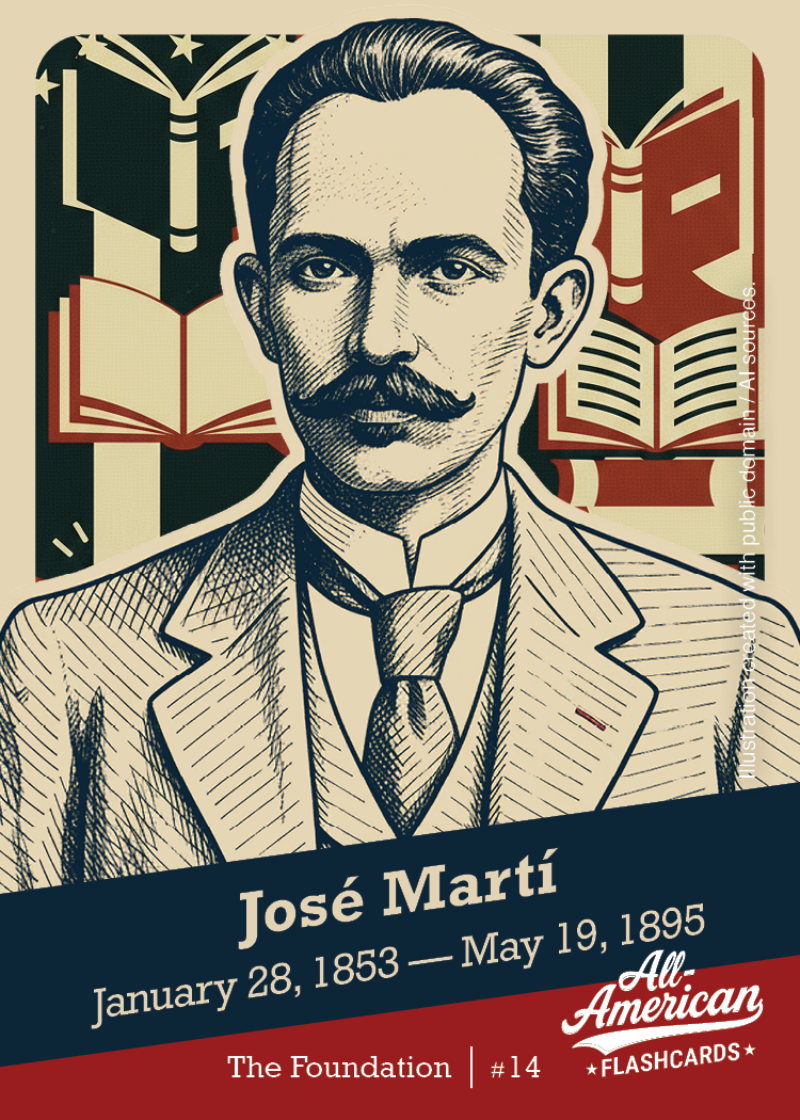
José Martí was a writer, journalist, organizer, and revolutionary thinker whose life linked political freedom, cultural dignity, and anti-imperial struggle across the Americas. Born in Havana in 1853 under Spanish colonial rule, Martí came of age in a world shaped by empire, censorship, and the growing desire for Cuban independence. He became politically active while still young and spent much of his life in exile, using writing and organizing to prepare the ground for liberation. Martí was not only a nationalist in the narrow sense. He was one of the most important political thinkers of the nineteenth-century Americas, and he understood that independence would mean very little if one form of domination was simply replaced by another. This is why his life matters so much. He fought Spanish colonialism, but he also warned against the danger of rising U.S. power in the hemisphere. Having spent important years in the United States, he admired certain aspects of American energy and civic life while also seeing clearly its racism, inequality, and expansionist ambition. His writing connected political freedom to moral seriousness, social justice, and the need for a people to define themselves on their own terms. Martí’s importance also lies in the way he treated literature and journalism as tools of struggle, not escapes from it. He understood that language helps shape whether people can imagine themselves as free. His death in 1895, early in Cuba’s final war for independence, made him a martyr in Cuban memory, but martyrdom should not overshadow the depth of his thought. He belongs in the broader American story because the United States did not develop in isolation from the rest of the hemisphere. Martí helps readers see the Americas as a connected political world, shaped by revolution, empire, and competing visions of freedom.
2
Why This Matters
José Martí matters because he helps readers see that the story of the Americas cannot be contained within the borders of the United States alone. The nineteenth century was shaped by struggles over empire, slavery, race, labor, and national sovereignty across the hemisphere. Martí belongs in the larger American story because he wrote and organized in the United States for years, watched U.S. power closely, and understood that the future of Cuba and Latin America would be affected not only by Spain, but also by the rising ambitions of the United States.
That broader perspective matters. Martí was not fighting only against Spanish colonialism. He was also warning against new forms of domination. He believed that formal independence would mean little if a nation remained economically dependent, racially divided, or vulnerable to foreign control. In that sense, Martí’s ideas were larger than patriotic rebellion. He was asking what genuine freedom would require.
His story also matters because he linked writing to political organizing in a way that still feels modern. He wrote essays, poetry, journalism, speeches, and letters, but he was not simply a literary figure observing politics from a distance. He helped build movements, shape public opinion, and organize for revolution. That matters because it shows that intellectual life and political struggle are not separate worlds. Martí used words to prepare people to act.
3
What They Don’t Usually Tell You
What many people do not usually hear is that Martí was not just a symbol of Cuban nationalism in a narrow sense. He was also one of the most important anti-imperial thinkers of his time. He worried deeply that Cuba could slip from Spanish rule into dependence on U.S. power. Because he spent significant time in the United States, he saw both its strengths and its dangers clearly. He admired energy and possibility, but he also saw racism, inequality, and expansionist ambition.
Another under-taught point is that Martí thought seriously about race and national unity. He argued that independence movements could not afford to reproduce the same divisions colonial rule had exploited. For Martí, the nation had to be built across racial lines, not as a project owned by one elite group. That did not mean the end of racial hierarchy in practice, but it does mean his politics cannot be reduced to a simple call for flag and sovereignty. He was trying to imagine a broader civic future.
People also often separate Martí the poet from Martí the revolutionary, but that division misses the point. His writing was part of his revolutionary work. He understood culture, language, and narrative as forces that shaped whether people could imagine themselves free. He knew that political struggle required moral and intellectual groundwork, not just weapons.
His death can also overshadow the larger sweep of his life. Martí died in 1895 early in Cuba’s final war for independence, and that sacrifice became central to his legend. But he should not be remembered only as a martyr. He was an organizer, strategist, essayist, and thinker whose warnings about empire would remain relevant long after his death.
4
Timeline / Context
1853 – José Martí is born in Havana, Cuba, under Spanish colonial rule.
Youth – He becomes politically active early and is punished by Spanish authorities for his pro-independence beliefs.
1870s – Martí experiences exile and travels through Spain and the Americas, developing his political and literary voice.
1880s – He spends important years in the United States, especially in New York, where he writes, lectures, and organizes among Cuban exiles and workers.
1890s – Martí intensifies his efforts to unify support for Cuban independence and helps found the Cuban Revolutionary Party.
1895 – Cuba’s final war for independence begins. Martí returns to Cuba and dies in battle that same year.
After 1895 – Martí’s writings and political thought continue shaping Cuban national identity and broader anti-imperial thought across Latin America.
This context matters because Martí’s life sat at the crossroads of old empire and rising new power. He was trying to help create a nation without letting it fall into another kind of dependence.
5
Key Terms
Colonialism – Control of one people or territory by another power. Martí fought against Spanish colonial rule in Cuba.
Independence – Political freedom from outside rule. For Martí, real independence required more than formal separation. It required dignity, unity, and self-determination.
Anti-imperialism – Opposition to domination by empires or powerful states. Martí’s writing often warned against replacing one empire with another.
Exile – Living away from one’s homeland, often for political reasons. Exile shaped Martí’s life, writing, and activism.
Cuban Revolutionary Party – The organization Martí helped build to support Cuban independence and political coordination.
6
Related People
- Simón Bolívar
Bolívar is a strong pairing because both figures represent major visions of independence in Latin America, though in different eras and contexts. Studying them together helps readers compare military liberation with later anti-imperial political thought. - Frederick Douglass
Douglass is a valuable connection because both men used language as a political weapon and thought seriously about race, freedom, and citizenship. Reading them together helps show how struggles for liberation across the Americas shared deeper questions about dignity and belonging. - César Chávez
If Chávez is in the deck, he can be a meaningful later connection because both figures linked cultural identity, public speech, and organized struggle. The comparison helps readers think about how political movements are built through both ideas and collective action. - Cuban Independence Movement
This is essential to explore because Martí’s legacy cannot be separated from the larger movement he helped organize. The connection helps readers see him not just as an isolated hero, but as part of a broader struggle over empire and nationhood.
7
Think About It
- Why did José Martí believe that political independence alone was not enough to guarantee real freedom?
- How does his story change the way we think about the relationship between the United States and the rest of the Americas?
- What role do writers and intellectuals play in preparing people for political change?
8
Take It Further
- Search “José Martí anti-imperialism” to explore why his ideas mattered beyond Cuban independence alone.
- Compare Martí and Bolívar to see how different generations imagined freedom in Latin America.
- Explore Martí’s years in New York and ask how living in the United States shaped his view of power and empire.
- Family discussion prompt: What does true independence require beyond lowering one flag and raising another?
9
Real-World Link
José Martí’s story remains relevant because struggles over sovereignty, foreign influence, cultural identity, and political dignity are still alive across the world. His warnings about empire speak directly to modern debates about economic dependence, military influence, and the difference between formal independence and real self-determination. He also matters in conversations about the Americas as an interconnected region. Too often, U.S. history is taught as if it develops in isolation, but Martí reminds us that people across the hemisphere were watching, responding to, and theorizing U.S. power long before the twentieth century fully unfolded. His life also speaks to the role of writers and journalists in public life. He shows that words can prepare a people to imagine freedom differently, but also that ideas alone are not enough without organization and sacrifice. Martí remains important because he linked thought, action, and moral seriousness in a way that still challenges anyone asking what liberation really means.


 Flashcards
 Games
Games Apparel & Homeware
 Travel
 Schools
 Memberships
 Sankofa Club (Children)
 About Us