

<< Go back to Main Page
Sarah Winnemucca
1
Quick Summary
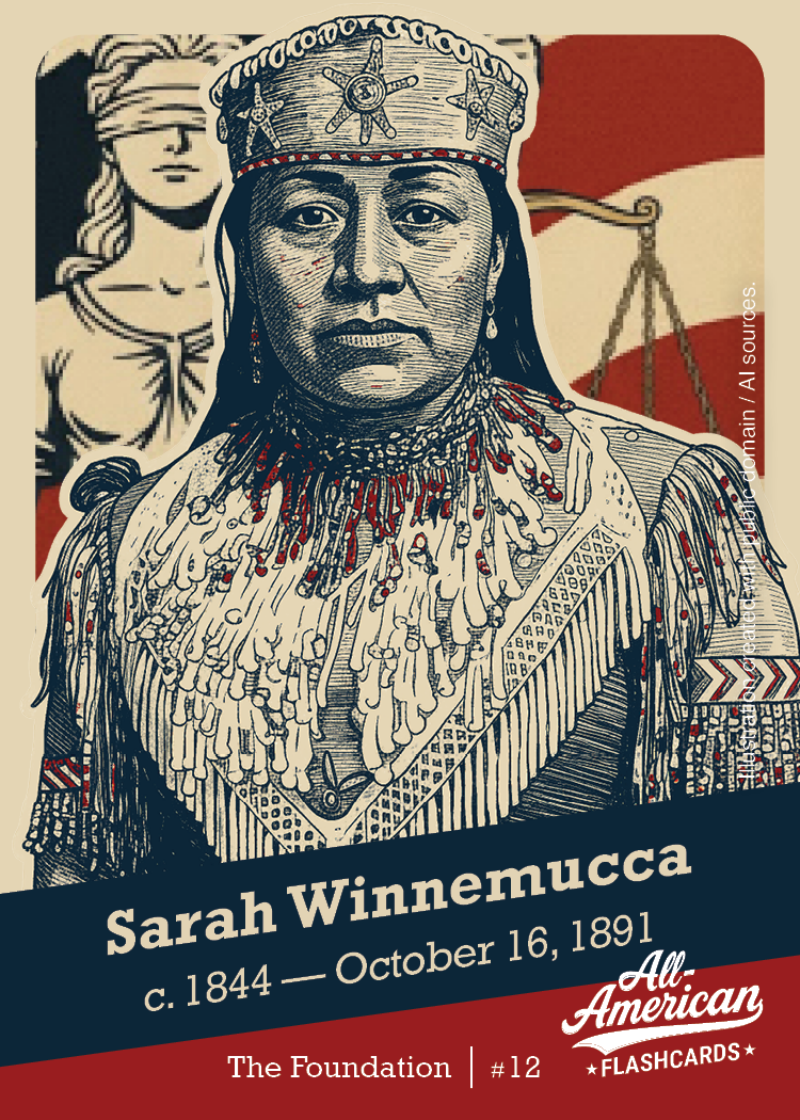
Sarah Winnemucca was a Northern Paiute writer, interpreter, lecturer, and activist whose life opened a powerful window into the violence, distortion, and political struggle of the nineteenth-century American West. Born around 1844 in the Great Basin, she grew up during a period when Native communities were confronting military pressure, settler expansion, reservation control, and the growing force of U.S. policy over Indigenous life. Winnemucca became one of the first Native women to speak directly to large non-Native audiences in English about what these changes were doing to her people. She did not simply translate language. She translated injustice. Through public lectures, advocacy, and her book Life Among the Piutes, she challenged the stories white America told about Native peoples and exposed the corruption, cruelty, and hypocrisy embedded in reservation policy. Her writing was historically important because it claimed something powerful: Native people had the authority to describe their own lives, their own suffering, and their own political reality. Winnemucca’s significance also lies in the difficulty of her position. She moved between Native and white institutions in a world where those institutions were profoundly unequal, and she often had to advocate inside systems already structured against her. That complexity makes her more compelling, not less. She was neither a simple symbol of accommodation nor a neatly packaged heroine of resistance. She was a public thinker trying to defend her people in a landscape of conquest, bureaucracy, and misrepresentation. Her life matters because it shows that Indigenous resistance was not only military. It was also intellectual, rhetorical, and deeply tied to the struggle over who would control the public story of the American West. Sarah Winnemucca belongs in the American story because she refused to let Native people remain silent subjects of someone else’s version of history.
2
Why This Matters
Sarah Winnemucca matters because she helps readers see that Indigenous resistance did not take only one form. Some leaders fought through military defense. Others fought through negotiation, refusal, cultural survival, writing, translation, and public testimony. Winnemucca belongs in the larger American story because she turned speech itself into a form of political intervention. She confronted audiences who often knew little about Native life beyond stereotypes and government propaganda. She made the violence of western expansion visible in human terms.
Her story also matters because she occupied a difficult and complicated position between worlds. Winnemucca could speak to U.S. officials, military officers, reformers, and white audiences in ways many Native people were denied the opportunity to do. That gave her a platform, but it also exposed her to misunderstanding, criticism, and impossible expectations. She was trying to advocate within structures that were already deeply unequal and often hostile. That is part of what makes her story so important. She shows the burden of being forced to translate suffering to people who benefit from the system causing it.
She also matters because of authorship. Native people have often been represented through the writing of missionaries, agents, soldiers, and settlers. Winnemucca instead wrote from her own experience and community knowledge. That matters because history is not only about what happened. It is also about who gets to tell the story. Her life belongs in the American story because she claimed the right to narrate Native reality in a public language the dominant society could not easily dismiss.
3
What They Don’t Usually Tell You
What many people do not usually hear is that Sarah Winnemucca’s life and legacy are not simple. She is sometimes presented either as a straightforward hero or, in some interpretations, as too accommodating to U.S. institutions. The reality is more difficult. Winnemucca was trying to defend her people in a world where Native communities were facing military power, starvation, confinement, and administrative control. She worked with some officials at times, criticized them fiercely at others, and navigated shifting circumstances that left little room for perfect choices. That complexity should not weaken her importance. It should deepen it.
Another under-taught point is that her advocacy was closely tied to the brutal reservation system. Winnemucca wrote and spoke about corruption, abuse, broken promises, and the suffering caused by federal Indian policy. She was not simply offering cultural explanation. She was exposing state and local injustice.
People also often underappreciate how groundbreaking her authorship was. Life Among the Piutes was not just a memoir. It was an intervention in public discourse. By publishing in English for a broad audience, she challenged the dominant monopoly over Native representation. She forced readers to hear Native perspectives in a form they could not easily ignore.
At the same time, it is important to remember that writing in English for non-Native readers always involves translation, selection, and pressure. Winnemucca was not writing from a place of equal power. She was trying to make a hostile society recognize truths it preferred not to see. That makes her work politically significant as well as historically valuable.
4
Timeline / Context
c. 1844 – Sarah Winnemucca is born into the Northern Paiute world of the Great Basin.
Childhood and youth – She grows up during intensifying contact and conflict between Native communities and settlers, traders, soldiers, and officials in the West.
1860s–1870s – U.S. western expansion accelerates—native communities in the region face displacement, violence, reservation confinement, and government control.
1870s – Winnemucca works as an interpreter and becomes increasingly involved in advocacy tied to the suffering of Native people under reservation policy.
Late 1870s–1880s – She begins lecturing publicly to non-Native audiences, describing injustice and defending the humanity and rights of her people.
1883 – She publishes Life Among the Piutes: Their Wrongs and Claims, an important milestone in Native-authored public writing.
Later years – She remains engaged in education and reform efforts, though her life continues to be shaped by the structural inequalities she spent years fighting.
1891 – Sarah Winnemucca dies, leaving behind one of the most important early Native-authored critiques of U.S. western policy.
This context matters because Winnemucca’s life unfolded during the height of federal efforts to control Native communities in the West. Her voice emerged not in a moment of peace, but in a system of pressure and dispossession.
5
Key Terms
Northern Paiute – An Indigenous people of the Great Basin region. Winnemucca’s identity and advocacy were rooted in this community and its experiences under U.S. expansion.
Interpreter – Someone who translates between languages and often between cultures. Winnemucca’s role as interpreter gave her influence but also placed her in a difficult position between unequal powers.
Reservation system – The federal system of confining Native nations to designated lands while restricting movement, autonomy, and access to traditional territory.
Life Among the Piutes – Sarah Winnemucca’s 1883 book, one of the earliest autobiographical works in English by a Native woman and a major critique of injustice.
Public testimony – Firsthand speaking or writing used to reveal truth, demand recognition, and challenge official narratives.
6
Related People
- Chief Joseph
Chief Joseph is a strong pairing because both figures reveal the human cost of Western expansion, but through different forms of leadership. Joseph is often remembered through war and removal, while Winnemucca shows how Native advocacy also worked through speech, writing, and public persuasion. - Sacagawea
Studying Winnemucca with Sacagawea helps readers compare how Native women have been remembered in American history. Sacagawea is often folded into national stories of exploration, while Winnemucca directly challenged national injustice and claimed a public voice on Native terms. - Zitkála-Šá
If Zitkála-Šá is in the deck, she is an especially meaningful connection because both women used writing and public speech to challenge how Indigenous people were represented. Reading them together helps trace a longer tradition of Native women shaping public discourse. - Tecumseh
Tecumseh is useful here because he represents an earlier model of Indigenous resistance built around confederacy and political sovereignty. Pairing him with Winnemucca helps show that Native resistance took different forms across time, place, and circumstance
7
Think About It
- Why is it so important for people to tell their own stories instead of being spoken for by outsiders?
- What kinds of pressure might someone face when trying to advocate for their people inside a system built against them?
- How does Winnemucca’s story change the way you think about leadership, especially for women under colonial rule?
8
Take It Further
- Search “Sarah Winnemucca Life Among the Piutes significance” to understand why her book matters in both Native and American literary history.
- Explore the history of the reservation system in the Great Basin and ask how policy shaped Native daily life.
- Compare Sarah Winnemucca and Zitkála-Šá to trace Native women’s public writing and advocacy across generations.
- Family discussion prompt: What happens when those most affected by injustice are denied the power to define their own story?
9
Real-World Link
Sarah Winnemucca’s story matters today because debates over representation, Indigenous rights, language, land, and historical truth are still active. Her life reminds us that being visible is not enough if the systems of power remain unequal. Native communities still fight to control how they are portrayed, how their histories are taught, and how federal and state governments respond to their rights. Winnemucca also speaks directly to modern conversations about translation and advocacy. Who gets heard when institutions make policy? Who is forced to explain their suffering repeatedly in order to be treated as fully human? Her work remains relevant because she insisted that Native people were not background figures in Western history. They were and are political communities with claims, memory, and voices of their own. That insistence is still necessary today.


 Flashcards
 Games
Games Apparel & Homeware
 Travel
 Schools
 Memberships
 Sankofa Club (Children)
 About Us