

<< Go back to Main Page
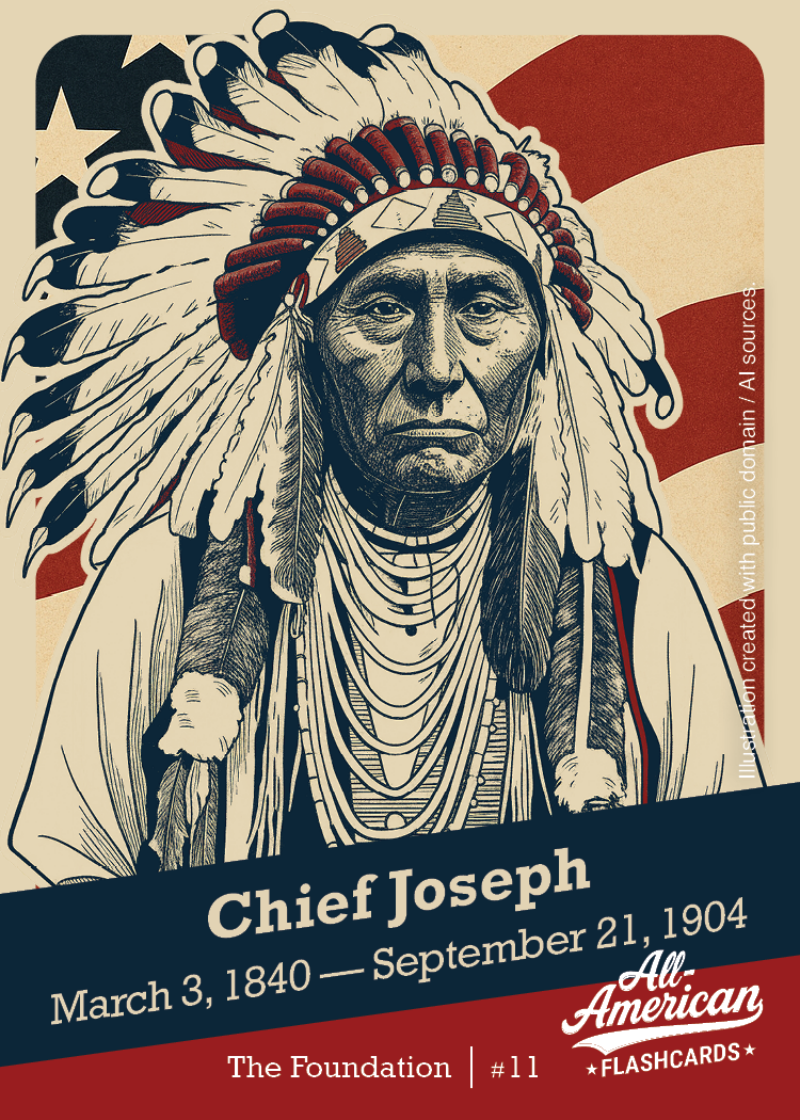
Chief Joseph
1
Quick Summary
Chief Joseph was a leader of the Nez Perce, or Nimiipuu, whose life became one of the most powerful symbols of Indigenous resistance, forced removal, and the defense of homeland in the nineteenth-century American West. Born in 1840 in the Wallowa Valley, he inherited a world in which his people’s connection to land was central not only to survival, but to identity, memory, and sovereignty. His historical importance is most often linked to the 1877 Nez Perce War, when U.S. military pressure and broken promises forced his people into a long and desperate retreat across the West. Yet Chief Joseph should not be understood only as the speaker of a famous surrender line or as a tragic figure at the end of a doomed struggle. He was a political leader responding to a long pattern of broken treaties, settler encroachment, and federal demands that his people abandon their homeland and accept confinement elsewhere. The war did not arise out of misunderstanding alone. It emerged from a larger U.S. system of expansion that treated Native land as negotiable whenever white settlement and state power demanded it. Chief Joseph’s leadership mattered because he tried to preserve life and dignity under conditions designed to make both nearly impossible. His public speeches later gave many Americans a glimpse of the injustice his people had suffered, but admiration for his eloquence often coexisted with refusal to return his people to their land. That tension remains central to his story. He was often praised sentimentally while the political truth of his cause was ignored. Chief Joseph belongs in the American story because he reveals the violence hidden beneath myths of westward progress. His life forces readers to see that U.S. expansion was not simply movement into empty space, but a contest over sovereignty, treaty obligation, and the right of Native peoples to remain where they had always belonged.
2
Why This Matters
Chief Joseph matters because he helps readers understand that Indigenous resistance was not only military. It was political, moral, and deeply tied to the defense of homeland and community. Too often, the story of westward expansion is told as if the United States simply grew. But growth for one society often meant dispossession for another. Chief Joseph belongs in the larger American story because he forces us to confront that reality directly.
His significance also comes from the kind of leadership he represented. He is often described as noble, eloquent, and humane, and there is truth in that. But those descriptions can become too soft if they are not grounded in the actual crisis he faced. Joseph was dealing with broken treaties, shrinking land, pressure from the U.S. government, and the impossible choice between submission and resistance. He was trying to preserve life under conditions designed to destroy Indigenous independence. That matters because it reveals the human cost of policies often hidden behind words like settlement, progress, and national destiny.
Chief Joseph also matters because memory itself is part of his story. In U.S. history, he is often remembered as one of the “good” Indigenous leaders because he came to symbolize dignity and sorrow rather than permanent rebellion. But even that memory can be misleading if it turns him into a passive emblem of loss rather than a political leader defending Native rights. His story belongs in the American story not because he lost, but because his life exposes what the nation was willing to do in order to expand.
3
What They Don’t Usually Tell You
What many people do not usually hear is that Chief Joseph was not necessarily the main war chief directing every tactical military decision during the 1877 conflict. He was an important political leader and public face of his people, but Nez Perce leadership was more complex than the simplified textbook version often suggests. Several leaders shaped the resistance, and understanding that helps prevent the story from becoming too centered on one man alone.
Another under-taught point is that the Nez Perce had long relationships with the United States before the war. This was not a sudden clash between strangers. There had been treaties, promises, negotiations, and increasing pressure as settlers moved into Indigenous lands. The 1855 treaty had recognized a large Nez Perce territory, but a later treaty in 1863, rejected by many Nez Perce bands, sharply reduced that land base after gold was discovered. That history matters because the 1877 war did not come out of nowhere. It grew from a pattern of broken commitments and escalating encroachment.
People also often remember the dramatic retreat toward Canada and the famous surrender speech, but less attention is given to what came after. Chief Joseph and his people were not simply allowed to go home after surrender. They were removed far from their homeland and suffered deeply. In other words, the surrender was not the end of suffering. It was part of a larger system of displacement that continued long after the battlefield headlines faded.
Chief Joseph also became famous partly because non-Native Americans found his public speeches compelling. That fame helped preserve parts of his story, but it also shaped how he was interpreted. He was often admired sentimentally while the larger system he criticized remained intact. That tension is important. It is possible for a nation to honor someone’s words while ignoring the justice of their cause.
4
Timeline / Context
1840 – Chief Joseph is born in the Wallowa Valley region of present-day Oregon, homeland of his people.
1855 – A treaty recognizes a large Nez Perce territory. This agreement reflects a period in which Native sovereignty still had visible political force, though it remained under pressure.
1863 – After gold is found, a new treaty drastically reduces Nez Perce lands. Many Nez Perce reject it, including Joseph’s community, which becomes known as “non-treaty” Nez Perce.
1870s – U.S. officials intensify efforts to force non-treaty Nez Perce onto a reservation outside their homeland.
1877 – The Nez Perce War begins after rising tensions, violence, and military pressure. Chief Joseph and others lead their people in a long and remarkable retreat across the West, fighting while trying to protect families and survive.
October 1877 – Near the Canadian border, exhausted and surrounded, Chief Joseph surrenders.
After 1877 – Joseph and his people are removed far from their homeland and endure years of hardship. He later travels, speaks publicly, and continues advocating for Native rights and justice.
1904 – Chief Joseph dies, still separated from the Wallowa homeland that had shaped his life and political struggle.
This context matters because it shows that Chief Joseph’s life cannot be reduced to one speech or one surrender. His story is about treaties, land, military force, memory, and the ongoing struggle over Native sovereignty.
5
Key Terms
Nez Perce / Nimiipuu – An Indigenous people of the Pacific Northwest. “Nez Perce” is the French-derived name commonly used in U.S. history, while Nimiipuu is the people’s own name for themselves.
Sovereignty – The authority of a people to govern themselves and maintain control over their land and political life. Chief Joseph’s struggle was rooted in defending Native sovereignty.
Forced removal – The coercive displacement of a people from their homeland. This was a recurring feature of U.S. policy toward Native nations.
Treaty – A formal agreement between nations. In Indigenous-U.S. history, treaties were often made under pressure and frequently broken or reinterpreted by the federal government.
Reservation – Land set aside by the U.S. government for Native peoples, often after seizure of far larger homelands. Reservations were part of a broader system of control and confinement.
6
Related People
- Tecumseh
Pair Chief Joseph with Tecumseh to explore two major Indigenous leaders who resisted U.S. expansion in different regions and eras. Studying them together helps readers see that Native resistance was not isolated or accidental. It was a long, continuing defense of sovereignty against growing federal power. - Sarah Winnemucca
Sarah Winnemucca is a strong connection because both figures dealt with the violence of U.S. expansion in the West, but in different ways. Chief Joseph is often remembered through military crisis and removal, while Winnemucca used speaking, writing, and translation to expose injustice and advocate publicly. - Sacagawea
This pairing is useful because it places two very different Indigenous stories side by side. Sacagawea’s life is often used in narratives of exploration and westward movement, while Chief Joseph’s story reveals the later consequences of U.S. expansion for Native homelands and survival. - Sitting Bull
If Sitting Bull is in the deck, he is an important comparison because both leaders became symbols of Native resistance, but in different political and military contexts. Reading them together helps widen understanding of how various Indigenous nations responded to federal aggression.
7
Think About It
- Why do you think U.S. history often remembers Chief Joseph’s sorrow more than the justice of his political cause?
- How does his story change the way you think about words like expansion, settlement, and progress?
- What is lost when Indigenous resistance is remembered mainly as tragedy rather than as a defense of sovereignty and homeland?
8
Take It Further
- Search “Chief Joseph 1855 treaty 1863 treaty” to better understand the broken promises behind the Nez Perce War.
- Explore the route of the 1877 Nez Perce retreat and ask what it means to move across such a vast landscape while protecting families under military pursuit.
- Compare Chief Joseph and Tecumseh to see how different Indigenous leaders confronted U.S. expansion in different centuries.
- Family discussion prompt: Why do powerful nations so often call land seizure “progress,” and how should we rethink that language?
9
Real-World Link
Chief Joseph’s story remains deeply relevant because struggles over Indigenous sovereignty, land rights, treaty responsibilities, and public memory are not over. Native nations continue to defend water, sacred sites, jurisdiction, and the meaning of treaty obligations in courts, legislatures, and on the ground. His life also matters because it reveals how national myths are built. The United States often honors Native leaders in symbolic ways while still resisting the full implications of their demands for justice. Chief Joseph reminds us that being remembered is not the same as being heard. His story pushes modern readers to ask what it means to praise Native dignity while failing to fully reckon with the systems that tried to destroy Native independence. In that sense, he is not only a figure of the past. He is part of an ongoing conversation about whose claims to land, belonging, and nationhood are taken seriously in America today.


 Flashcards
 Games
Games Apparel & Homeware
 Travel
 Schools
 Memberships
 Sankofa Club (Children)
 About Us