

<< Go back to Main Page
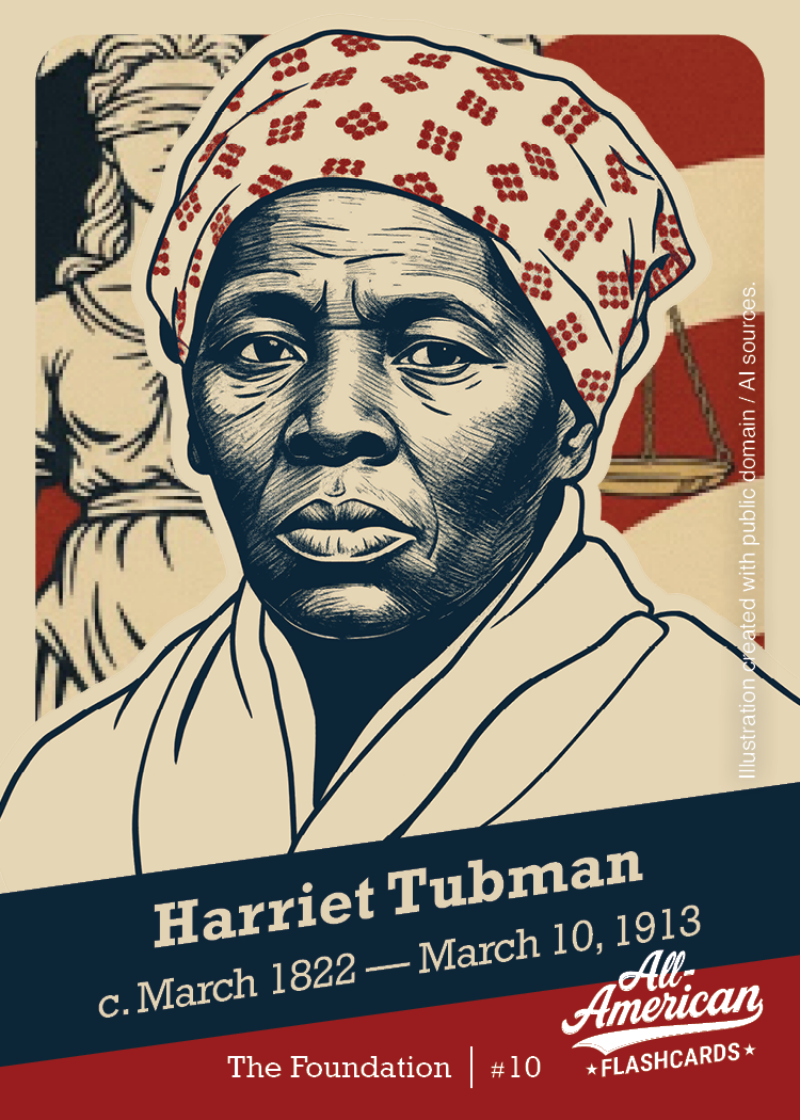
Harriet Tubman
1
Quick Summary
Harriet Tubman was an abolitionist, rescuer, wartime operative, and one of the most extraordinary freedom fighters in American history. Born into slavery in Maryland around 1822, she grew up in a system built on violence, forced labor, family separation, and constant surveillance. After escaping slavery herself, Tubman made the radical decision to return again and again to guide others out of bondage, turning her own freedom into a mission rather than a private escape. Through the Underground Railroad, she helped enslaved people move through one of the most dangerous landscapes in the United States, where capture could mean brutal punishment, sale, or death. Her courage was never random or reckless. It was strategic, disciplined, and rooted in careful judgment, timing, secrecy, and an extraordinary willingness to act under pressure. Tubman’s importance also extends beyond the Underground Railroad. During the Civil War, she served the Union as a nurse, scout, guide, and intelligence operative, helping make her one of the few women in U.S. history to play such a direct role in wartime liberation. Her work in the Combahee River Raid, which helped free hundreds of enslaved people, reveals how broad her contribution to the struggle for freedom really was. Tubman matters because she forces us to understand that the destruction of slavery was not achieved only by presidents, generals, or lawmakers. It was also driven by formerly enslaved people who risked everything to break the system from within. Her life expands the meaning of leadership by showing that power can come through service, strategy, endurance, and moral clarity rather than formal office. Harriet Tubman belongs in the American story because she made freedom real for other people at immense personal risk. She remains one of the clearest examples of what it means to turn survival into resistance and resistance into lifelong purpose.
2
Why This Matters
Harriet Tubman matters because she changes the scale of what many people imagine when they think of resistance. Slavery was not only a cruel labor system. It was a tightly enforced regime of surveillance, violence, sale, and control. To escape it required more than bravery. It required planning, timing, secrecy, geographic knowledge, trust, and the ability to act under extreme pressure. Tubman mastered all of those. Then she did something even more extraordinary: she went back.
That matters because her story reveals that the struggle against slavery was not only driven by lawmakers, generals, or reformers speaking from a distance. Enslaved and formerly enslaved people themselves were central agents in breaking the system. Tubman belongs in the larger American story because she represents direct action against one of the nation’s deepest evils. She did not wait for permission from courts or politicians. She moved in defiance of unjust law and built pathways to liberation in real time.
Her story also matters because it widens the meaning of leadership. Tubman held no office, commanded no formal army for most of her life, and had little institutional backing. Yet she altered lives, challenged a national system, and later contributed to wartime operations that advanced freedom on a larger scale. She shows that leadership can be strategic, hidden, collective, and rooted in service rather than status.
3
What They Don’t Usually Tell You
What many people do not usually hear is that Tubman’s life involved far more than a few daring rescue trips. Popular memory can reduce her to a single role: conductor on the Underground Railroad. That role is essential, but it is not the whole story. Tubman also worked during the Civil War for the Union as a nurse and intelligence operative. Most famously, she helped lead the Combahee River Raid in South Carolina in 1863, an operation that helped free hundreds of enslaved people. That makes her one of the few women in U.S. history associated with the leadership of a military-style raid during the war.
Another under-taught point is that Tubman lived with long-term physical effects from violence. As a child, she was struck in the head by an overseer, an injury that caused pain and episodes for the rest of her life. Her courage should not be separated from that reality. She was not fearless because life had spared her suffering. She was courageous despite trauma, danger, disability, and constant risk.
People also often tell her story in a polished, almost legendary way that can unintentionally remove the terror. The Fugitive Slave Act made escape even more dangerous by extending the reach of slave-catching into free states. Every journey Tubman made northward, and every return trip south, took place inside a legal regime that claimed she and those she rescued were property. That matters because it shows how radical her actions were. She was not simply helping people travel. She was breaking a human property system at the point where it most relied on obedience and fear.
Her later life matters too. Tubman continued working for justice after the war, including efforts connected to Black community support and women’s suffrage. Like many great freedom fighters, she did not receive the full material recognition her service deserved during her lifetime. That gap between praise and support is part of the story too.
4
Timeline / Context
c. 1822 – Harriet Tubman is born into slavery in Maryland as Araminta Ross.
Childhood – She endures forced labor, family instability, and severe violence, including the head injury that affects her throughout life.
1849 – Tubman escapes slavery and reaches freedom in the North.
1850s – She returns multiple times to the South to guide family members and others to freedom through the Underground Railroad.
1850 – The Fugitive Slave Act intensifies the danger of escape by allowing capture efforts to extend into free states.
1850s – Tubman works within abolitionist networks and becomes increasingly known among anti-slavery activists.
Civil War era – She serves the Union as a nurse, scout, guide, and intelligence operative.
1863 – Tubman helps lead the Combahee River Raid, which results in the liberation of hundreds of enslaved people.
Postwar years – She continues advocating for Black communities and later supports women’s suffrage.
1913 – Tubman dies after a life devoted to freedom and service.
This timeline matters because Tubman’s life did not move from slavery to freedom and then stop. She kept expanding what freedom required.
5
Key Terms
Underground Railroad – A network of routes, safe houses, and people who helped enslaved individuals escape to freedom. It was not a literal railroad, but a covert resistance system.
Fugitive Slave Act – A law that strengthened the capture of escaped enslaved people, even in free states, making freedom more precarious and resistance more dangerous.
Self-emancipation – The act of enslaved people freeing themselves rather than waiting for liberation from others. Tubman’s life is a powerful example.
Combahee River Raid – A Union military operation in South Carolina in 1863 in which Tubman played a major role, helping free hundreds of enslaved people.
Abolitionist – A person committed to ending slavery. Tubman’s abolitionism was deeply practical and action-based.
6
Related People
- Frederick Douglass
Douglass is one of the strongest people to pair with Tubman because both were formerly enslaved and turned freedom into a larger mission. Douglass fought slavery with speeches, writing, and political advocacy, while Tubman fought it through direct rescue, intelligence work, and action under cover of danger. - Sojourner Truth
Truth connects because she and Tubman were both Black women whose lives shattered narrow assumptions about leadership, courage, and public influence. Studying them together helps readers see how Black women shaped the freedom struggle through different but equally powerful forms of resistance. - John Brown
Brown is a useful connection because Tubman respected him and was connected to militant abolitionist circles. Pairing them helps readers think about the broad range of anti-slavery struggle, from covert rescue networks to armed resistance. - Clara Barton
This is a meaningful Civil War-era pairing because both women contributed through service in wartime, though in different forms. Comparing them helps readers think about care, logistics, intelligence, and the many kinds of labor that helped advance freedom during the war.
7
Think About It
- What does Harriet Tubman’s life teach us about the difference between freedom for oneself and freedom as a responsibility to others?
- Why do you think some forms of resistance are celebrated only after the danger has passed?
- How does Tubman’s role in the Civil War change the way we think about women’s leadership in wartime?
8
Take It Further
- Search “Harriet Tubman Combahee River Raid” to explore her Civil War role beyond the Underground Railroad.
- Compare Tubman and Frederick Douglass to see different forms of Black leadership in the anti-slavery struggle.
- Explore how the Fugitive Slave Act changed the geography and danger of freedom.
- Family discussion prompt: What kind of person risks their own hard-won freedom to go back for others, and what does that reveal about the meaning of courage?
9
Real-World Link
Harriet Tubman’s story remains powerful because it speaks to how real change often depends on people willing to act before institutions catch up. She reminds us that unjust systems rarely collapse on their own. They are resisted, undermined, and broken by people who refuse to cooperate with them. Her life also connects strongly to modern conversations about courage, mutual aid, state violence, and who gets remembered as a national hero. Tubman is often admired in symbolic ways, but a deeper reading of her story is far more demanding. She was not simply kind or brave in a general sense. She was disciplined, strategic, radical, and willing to violate unjust law repeatedly. That matters now because societies still debate the legitimacy of resistance when legal systems fail to protect human dignity. Tubman also expands the meaning of service. She was rescuer, operative, caregiver, and leader. In a country that often narrows history to officeholders and generals, Tubman stands as a reminder that some of the most important nation-shaping figures are the ones who moved through danger to make freedom real for other people.


 Flashcards
 Games
Games Apparel & Homeware
 Travel
 Schools
 Memberships
 Sankofa Club (Children)
 About Us